
July 18th – Visits to the Mercato Albinelli and the Acetaia Comunale.

Walking Towards the Mercato’s Humble Southwest Conrer at Noon.
Our class walked a short distance to the famous Mercato Albinelli located on the old Piazza Grande. It was a very hot day which unfortunately detracted from our group fully enjoying all the sights, sounds, and smells of the market’s shops and restaurants. Viewed from the outside the covered mercato looks like a rather nonchalant building with the exception of its large iron gates in the front and the back. Inside the mercato is a beehive of activity.
Later, back in the classroom I was able to review the mercato’s website. It shares a brief history, photo gallery, and an informative three-minute introductory video in Italian, but with English subtitles. The video explains that the market was strategically located aside the city’s former fish market and slaughterhouse. In the early part of the 20th Century a forerunner of present structure was built. Today’s covered structure was completed in October, 1931. Its symmetrical isles, booths and shops comprise about 1,000 square meters. Of note, keeping with the 1930’s era the structure was designed in the Art Nuevo style.
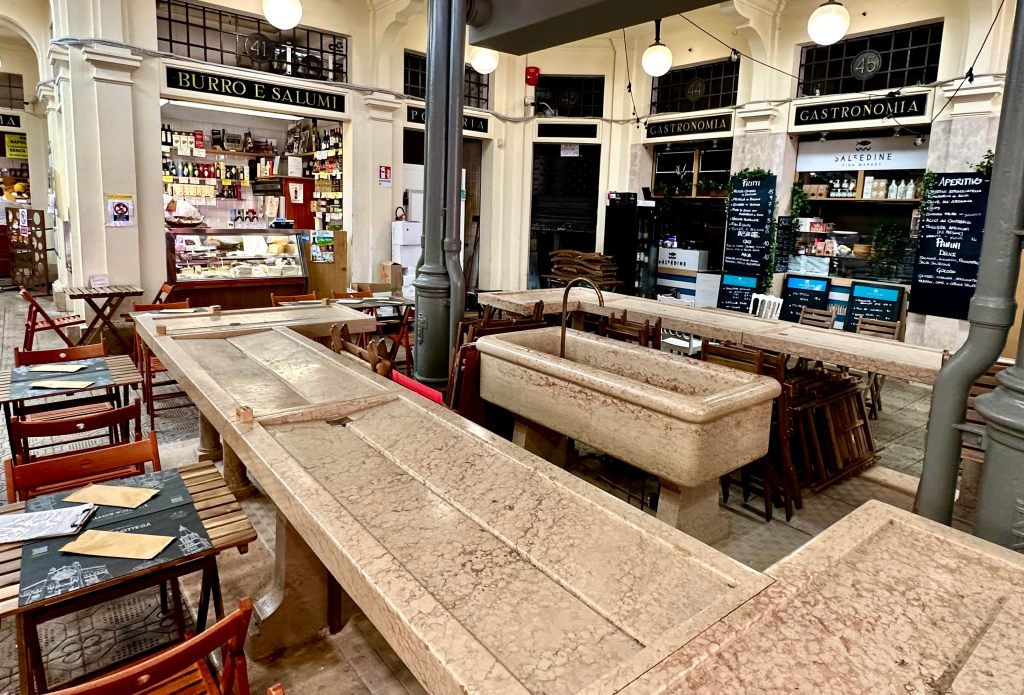
Old Fish Market Marble Components Repurposed in a Mercato Ristorante.
Artistic note: The bronze statue “little girl with a basket of fruit” located in the center of the mercato was created by Italian sculptor Giuseppe Graziosi and is also a water fountain.

Graziosi’s “little girl” Statue and a Local Bank’s Thermometer (91° F).
Political note: The mercato was named after Modena’s 1930’s Mayor Albinelli. From a cultural heritage viewpoint, the market perpetuates local cuisine and intermingles people from all walks of life in the city. Everybody has to eat and what a place to experience all this heritage.
After lunch our class went up to the attic of Modena’s city hall where a local non-profit creates and supports the region’s famous Balsamic Vinegar. This product is PDO, that is it has special legal status as a European food item with a Protected Designation of Origin. See assigned readings from Antonelli, 2021 and Flinzberger, 2022.
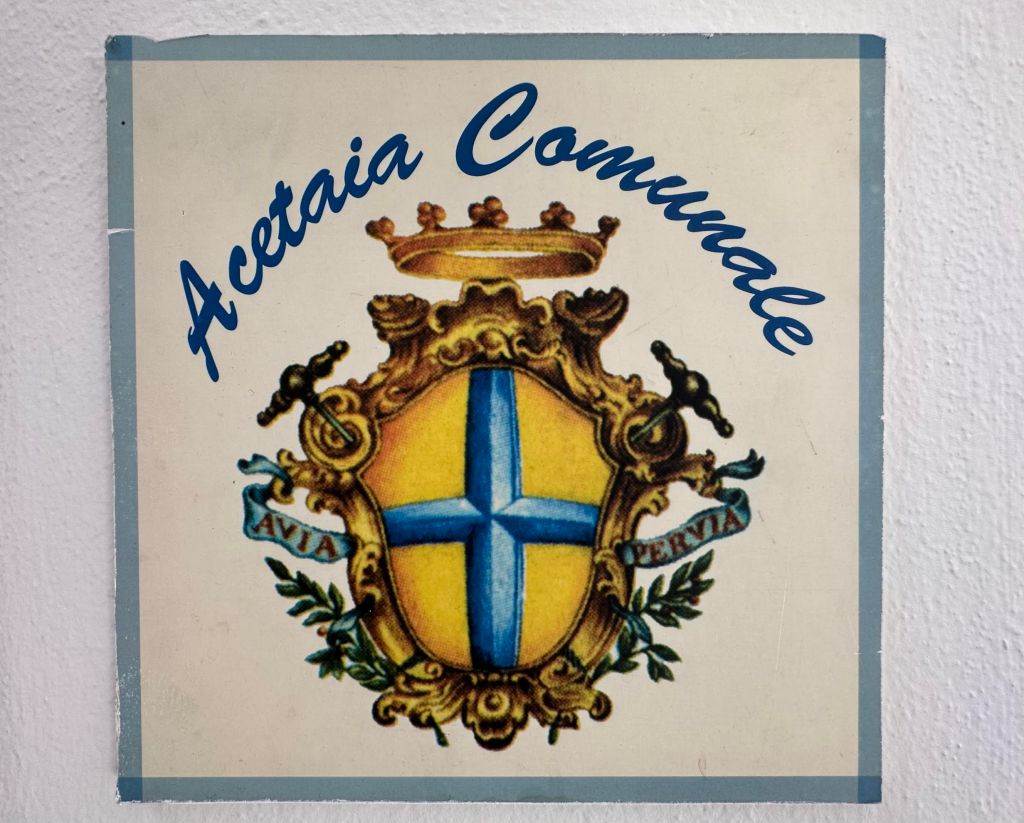
The Association’s Heraldic Crest & Latin Motto “AVIA PERVIA”
Translated “(let) difficult paths (be made) easy to walk”
https://forum.wordreference.com/threads/avia-pervia.1069206
The Consorteria dell’Aceto Balsamico Tradizionale di Spilamberto,AKA the Acetaia Comunale is the name of the organization headquartered up in the attic. It’s way up there because two key components in making Modena’s Balsamic Vinegar are space and heat. The space requirement is predicated upon enough room for a minimum of 11 barrels and a maximum of 25 barrels. FYI, the two recognized aging periods for marketing purposes this product are 11-years and 25-years. The two types of balsamic vinegar are named affinato (11-years) and stravecchio (25-years, or more), respectively.
Signora Giordano explained that the custom of families producing their own balsamic vinegar goes back many centuries and has been passed down along maternal lines from grandmothers and mothers to granddaughters and daughters. In one sense their local balsamic vinegar was much like a dowry. However, the continuity of passing on the craft is threatened by a number of factors. First, the start-up costs are high for new barrels and the must – a grape juice concentrate used to initially formulate the balsamic vinegar. Second, the construction methods of modern times rarely include attics, if at all, or other large warm storage spaces.
On the bright side of cultural continuity for this craft despite fewer families brewing the balsamic vinegar the association helps pass on the craft skills by annual competitive taste testing known as The Palio.
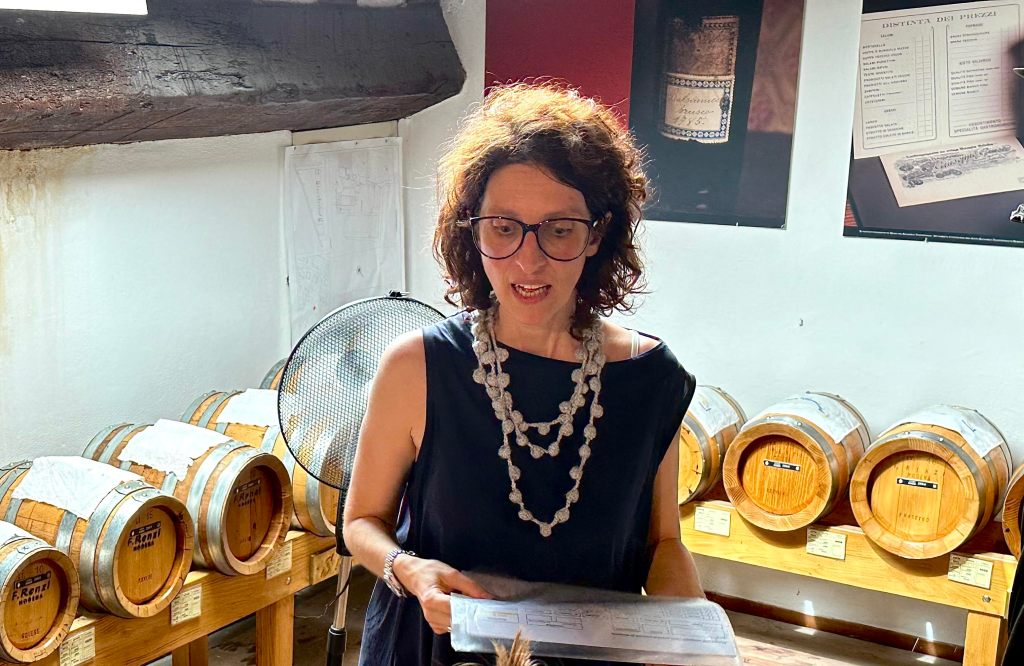
Our Guide, Volunteer – Signora Alessandra Giordano
Although I didn’t fully understand the biological process it was explained that making the balsamic vinegar is essentially the very opposite of making wine. That is, fermentation is prevented and an anerobic-evaporative process produces the vinegar over the decades.

I Knew at Least One Classmate Would Say “Regular and High-Test.”
We were offered small samples of the affinato (11-year) and stravecchio (25-year) products. I was not accustomed to the strength of either but found the flavors very interesting. The two standardized grades of Modena’s Balsamic Vinegar are sold in 100cc bottles. At the recommendation of Professor Padovani, I dined at Ristorante Di Danello and greatly enjoyed a small steak which had been marinated in Modena’s Balsamic Vinegar. FYI, the chef would not reveal how long the steak is marinated – it’s a chef’s trade secret recipe.
References:
Antonelli, F., 2021. Region Emilia Romagna ranks first in the list of excellence delis (PDO and IGP food products). Emilia Romagna Tour Guide, published 15 April, 2021. https://en.emiliaromagnatourguide.com/post/region-emilia-romagna-ranks-first-in-the-list-of-excellence-delis-pdo-and-igp-food-products
Flinzberger, L. et al, 2022. EU-wide mapping of ‘Protected Designations of Origin’ foodproducts (PDOs) reveals correlations with social-ecological landscapes. Agronomy for Sustainable Development, pp. 42-43. https://link.springer.com/article/10.1007/s13593-022-00778-4
Mercato Albinelli, n.d. Albinelli Market – History Webpage, Il Coure di Modena, Modena, IT. https://www.mercatoalbinelli.it/la-storia/
Visit Modena, Acetaia Comunale di Modena – Webpage. Official Tourist Information Site of Modena, IT. https://www.visitmodena.it/en/discover-modena/land-of-flavors/the-vinegar-factories/municipal-balsamic-vinegar-factory-of-modena
 Grande Giro di Modena