
July 19th
July 19th – a very fast paced day. Four Site Visits & Two Lectures: Piazza Grande – Torre Ghirlandina (Garland Tower), Musei del Duomo, Musei Lapidario Del Duomo, and the Cathedral Corso Duomo. Some people might ask “During these overseas cultural heritage seminars what do the JHU students and their professors do during their spare time?”

The Duomo Main (West) Entrance and the Ghirlandina Torre – Back Left.
Our tour of Torre Ghirlandina was led by Dottore Francesca Piccinini who holds two esteemed positions. First, she is the site Coordinator (AKA Manager) for Modena’s UENSCO World Heritage Site. Second, she is the Director of the Museo Civico di Modena [EN: Modena Municipal Museum]. Dottore Piccinini’s lecture encompassed the four UNESCO criterion cited (i, ii, iii, & iv) for Modena’s World Heritage Site 1997 Inscription. Plus, she offered several comments regarding this World Heritage Site’s uniqueness.
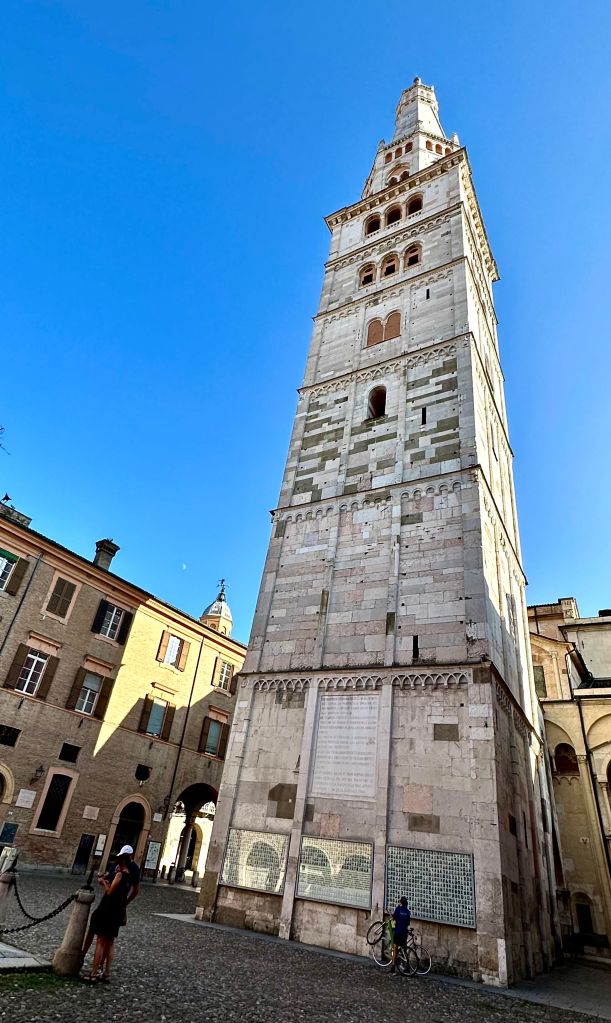
Ghirlandina Torre Viewed from the North
An assigned reading (Cadignani, 2019) provided a very detailed history of the tower and its construction and at the other end of the scale a simple four-page brochure (see Comune di Modena, 2019) provides one sufficient basic information about the ‘Garland Tower.’ It was lovingly named for the two carved marble balustrades which crown the tower’s spire. From a cultural heritage perspective, the Torre Ghirlandina has it all – that is; art, archaeology, architecture, economic and political eras of change, turmoil, and upheaval and warfare.
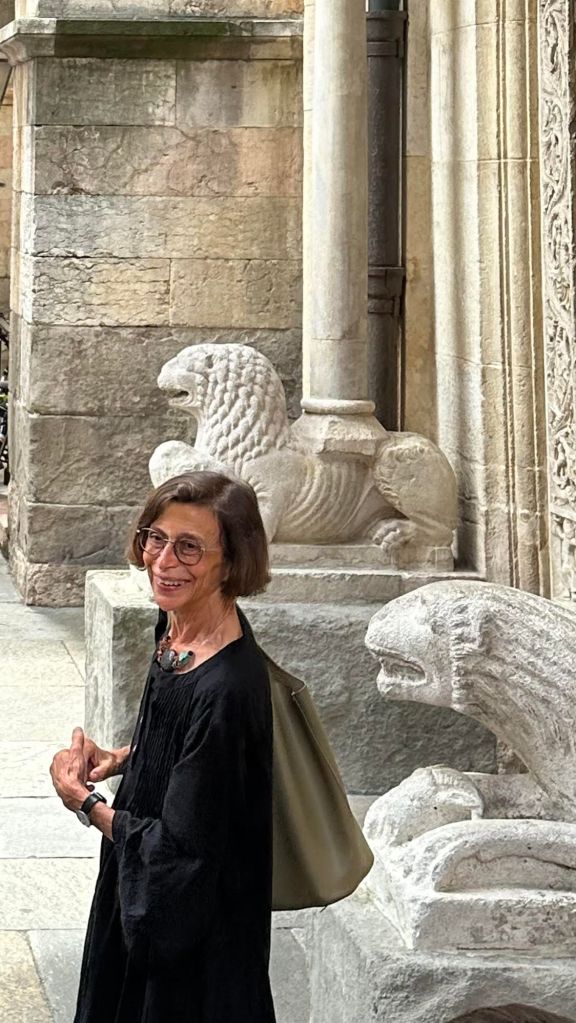
Dotorre Franschsca Piccinini with Two of Her Beloved Duomo Lions.
There are two key construction details concerning the tower and the duomo. They were both built in phases with a hodge-podge of cut stones. Some stones were reutilized Roman ruins, and others came from various regions of Italy and in one case stones came from Turkey. The second key detail is that the soil of Modena is unstable clay and alluvial silt. Neither type lends itself to supporting heavy structures. Therefore, the nearly 90-meter-high tower presently tilts 1.6 meters off center. Plus, that’s taking into consideration a correct-it-as-you-build methodology. That is, the church and tower were both built in on-and-off construction projects carried out over two centuries (1099 – 1319).

Biblical Carved ‘Story Telling’ Scenes on the Front Exterior of the Duomo.
Specifically, each of the tower’s distinct seven phased sections were re-plumbed to true vertical in order to compensate for the collective tilt from all the prior phased sections, yet the tilt persisted as the soil still shifted [rhyme intended]. Furthermore, it should be noted the Gothic arches connecting the tower and duomo are not just for aesthetics. They were constructed in 1338 with the key purpose of arresting the Garland Tower’s precarious tilt towards the duomo.

Gothic Arches Added in 1338 to Support the Tower – So Far – So Good…
Regarding the Duomo’s uniqueness, Dottore Piccinini emphasized the creative work of the Campeonesi masters who simultaneously created and integrated the architecture and the sculpture of the Romanesque Italian cathedrals. In this case, the architect was LaFranko and the sculptor was Wiligelmo. Furthermore, Dottore Piccinini answered several questions about her UNESCO World Heritage Site responsibilities. She discussed at some length the various funding challenges and the 2018 instrumentation project (tower tilt monitoring). One more note on the duomo’s uniqueness. Economics of the middle ages (on-and-off again funding) was a factor in utilizing local building materials, namely brick produced from local clay and sand. So, most of the duomo’s interior pillars were made from local bricks.
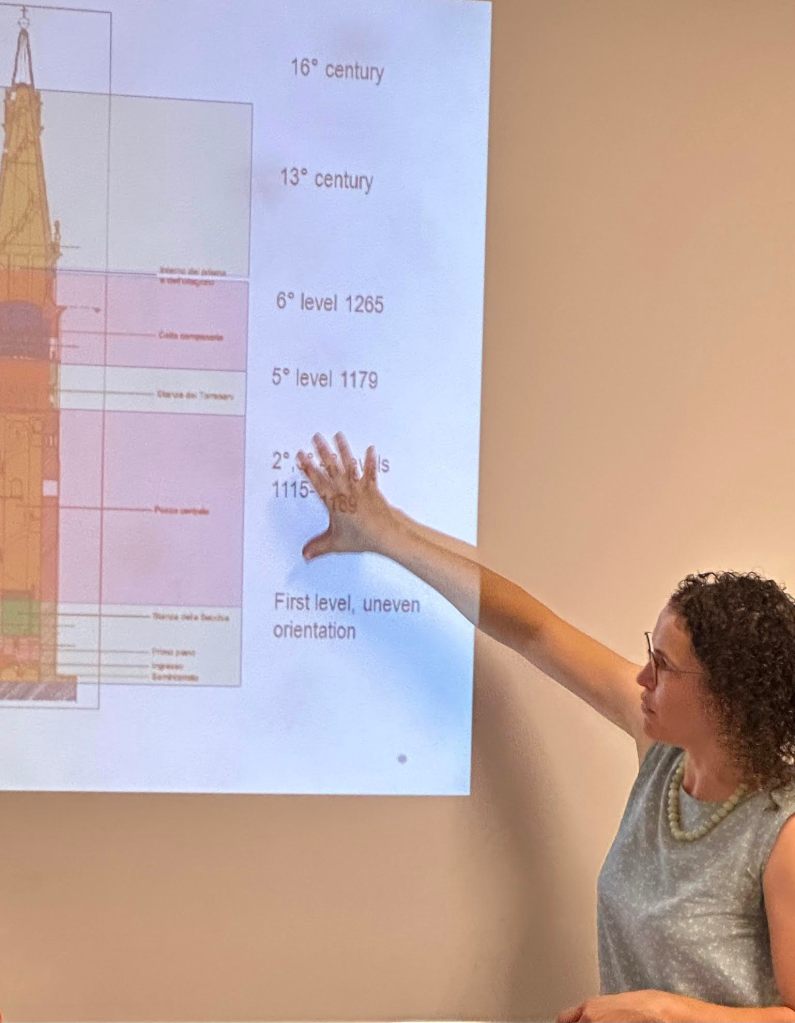
Dottore Ava Coisson Outlines The Ghirlandina’s Levels and its Years…
Dottore Ava Coisson, a Civil Engineer and a Professor of Architecture at the University of Parma, accompanied the class on the tour of Torre Ghirlandina. Afterwards she presented a detailed, informative lecture about her structural analyses of Modena’s cathedral and tower. A key aspect of Dottore Coisson’s lecture “Listening to Buildings” is that if you listen closely, they will tell you some of their history that has been lost over the centuries. She offered this statement, “The monument is a document itself.” She also commented on buildings as “The Great Mute” and referred to an Italian architect whose name I misunderstood and misspelled because I could not find information on him (Gianoche?).

Replica of the Stolen Bologna Bucket in the Tower’s Former Treasury.
Dottore Coisson, along with a diverse team of experts have conducted similar structural studies for restoration and safety considerations in Florence and Parma. A unique aspect of Professor Coisson’s work features high-tech forensic analysis of both building materials and building methodologies for ancient structures. Yet she readily declared that many valuable clues can be discerned via older low-tech methodologies.

A Terra Cotta Alter in the Duomo.
One facet of her team’s analyses is to best determine the damages caused by specific earthquakes known to have occurred in specific years. In some cases, the team’s scientifically derived history [student’s description] becomes a structure’s only history because there is minimal or no surviving written, history.
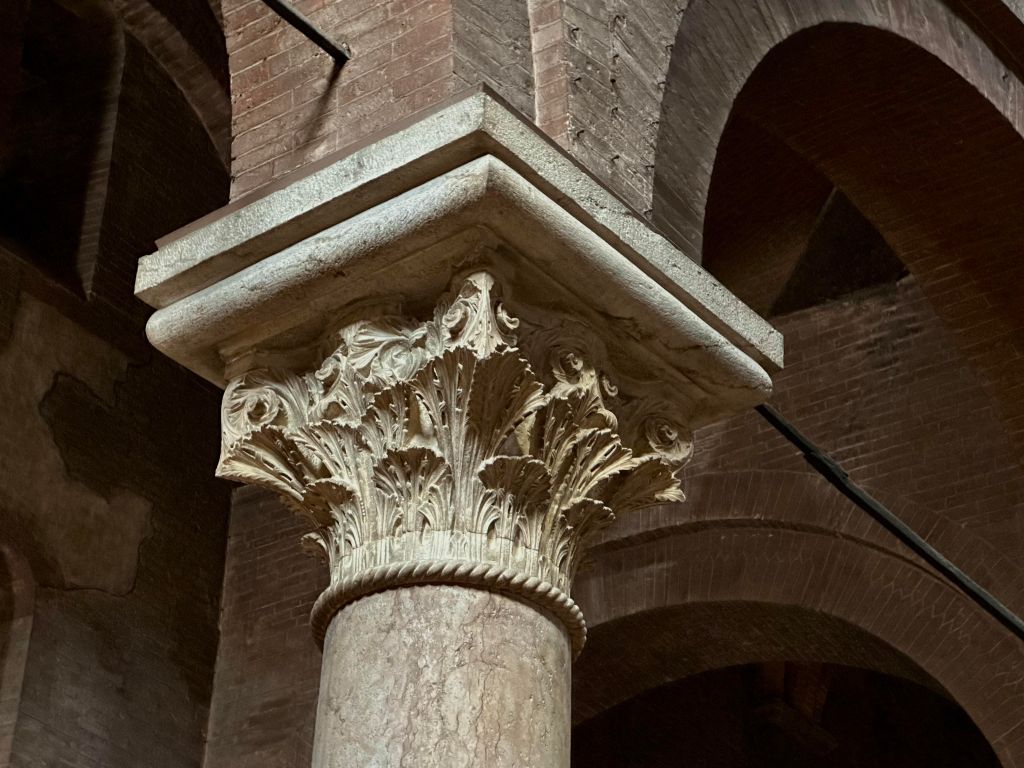
A Beautiful Corinthian Capital Atop One of the Few Stone Duomo Pillars.
Dottore Coisson’s work has focused on not only repairing the damage caused by earthquakes (recent and ancient) but also focuses on formulating structural improvements as preventative measures to minimize damages from future earthquakes.
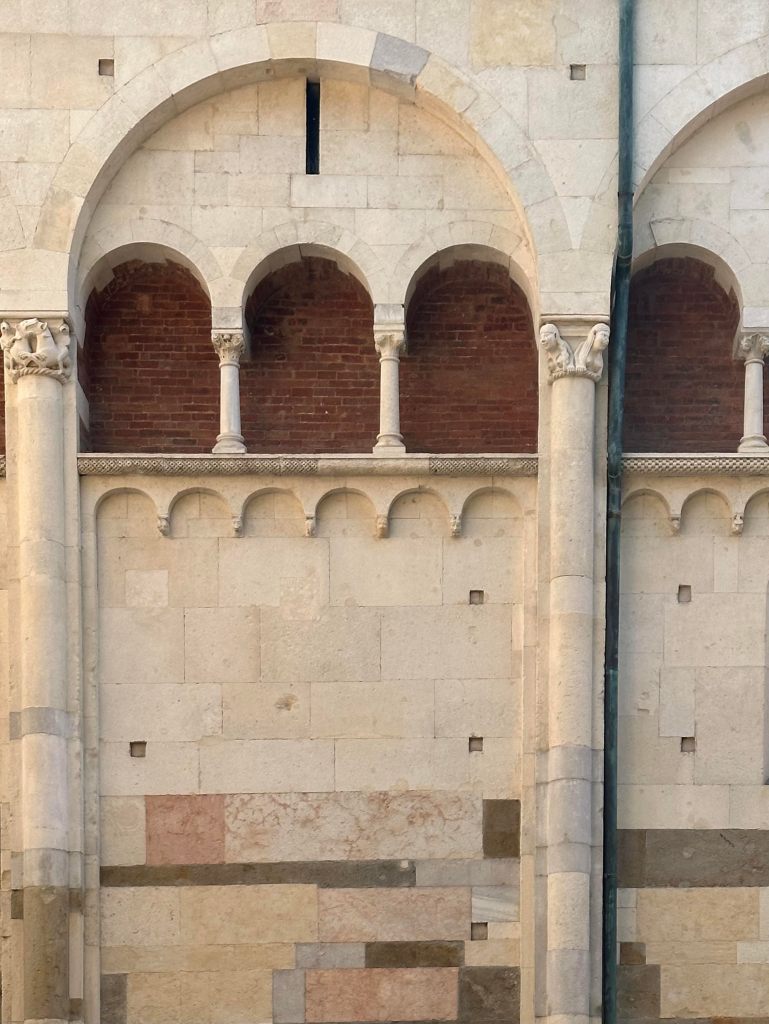
Bonus Points > Name Every Kind of Stone on the Duomo’s Exterior…
Another component to Listening to Buildings is comparative structural analysis. Regarding this, Dottore Coisson gave the key example of the Speyer Cathedral in Speyer, Germany. It’s another UNESCO World Heritage Site for a Romanesque cathedral which has many similarities to Modena’s Cathedral Corso Duomo. In fact, many of the similarities go well beyond mere similar appearance. Several detailed architectural analyses have confirmed both identical design and construction techniques for specific portions of the structures.

Take Note of the Duomo’s Brick Pillars and Metal Reinforcement Bars.
These factors include the types and arrangement of bricks, colors, dimension, and structural details. So, in this manner some of the recorded history of the Speyer Cathedral which directly corresponds by intense comparison can be applied to the missing history of Modena’s Cathedral Corso Duomo. Note: Afterwards, I overheard many students say that they wished Dottore Coisson could have stayed longer and I’m of the same sentiment.

High Tech in the Museum – Select the Stone – See its Location…
The tours of the Museo del Duomo and the Museo Lapidario Del Duomo were led by Curator Francesca Fontana. She was overflowing with enthusiasm over the extensive renovation and expansion of the Duomo Museum. She was comfortable answering student’s questions and when she didn’t have an answer, she encouraged students to research the matter further and share their results with herself and others. That agile response shows excellent potential for Curator Fontana to become a university professor.
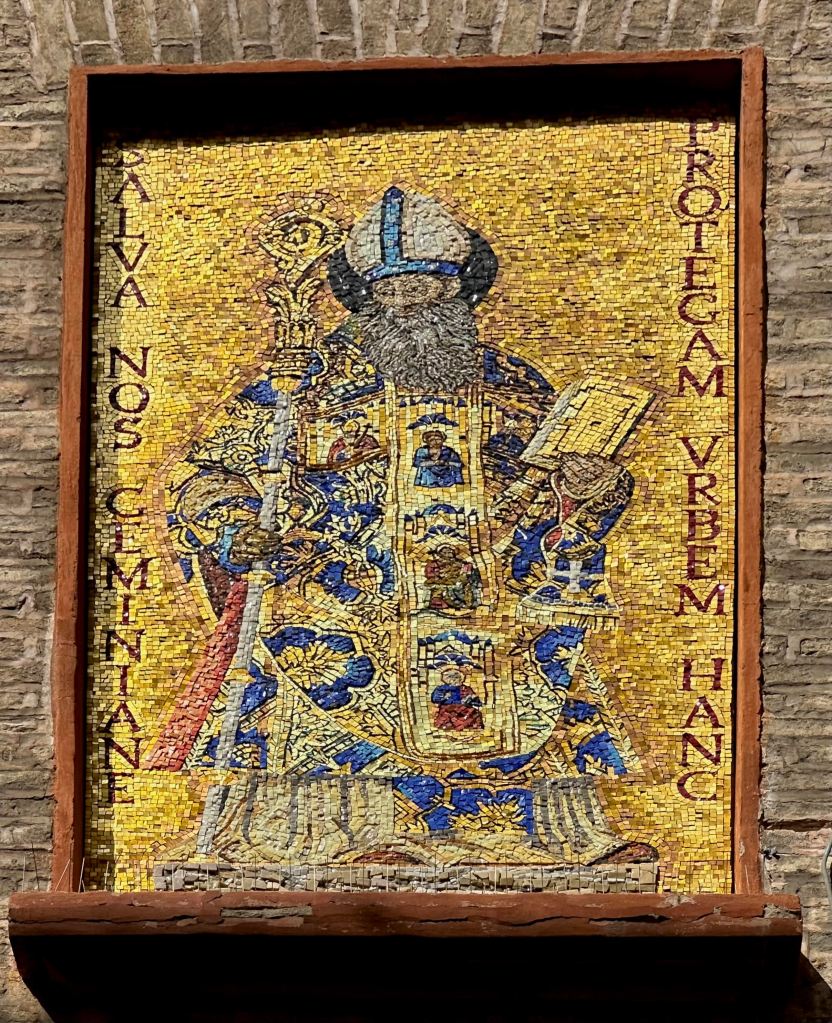
Patron Saint Gemianane’s Mosaic Looking at the Duomo from the Museum.
The church museum faithfully enhances and explains so much of what visitors see in the duomo. Its interpretive displays detail the various construction materials and methods. Plus, they also elaborate on the duomo’s interior artistic carvings, paintings, and reliefs.

An Intricate, Scaled, Hand-Built Model of the Doumo and the Torre.
Furthermore, the state-of-the-art cathedral museum also smoothly integrates both older and newer technologies to inform and motivate the visitor’s and pique their interests in Modena’s Duomo – Cathedrale Metropolitana di Santa Maria Assunta e San Germiniano. It’s very obvious that a great deal of care and innovation went into planning this museum.
One point of clarification. The Doumo’s Museo Lapidario is a relatively small display of stone artifacts discovered in the immediate vicinity of the Duomo. Down the road is the much larger Estense Lapidary Museum, a key component of the city’s civic museum.
References:
Archeosistemi, 2022. Torre Ghilandina-Ex Diurno-Historical Rooms – Webpage. AR/S Archeosistemi Cooperative Company, Reggio Emilla, IT. https://archeosistemi.it/progetti/torre-ghilandina-ex-diurno-sale-storiche
Cadignani, R., Lancellotta, R, and Sabia, D., 2019. The Restoration of Ghirlandina Tower in Modena and the Assessment of Soil-Structure Interaction by Means of Dynamic Identification Techniques, CRC Press, London, UK. https://www-taylorfrancis-com.proxy1.library.jhu.edu/pdfviewer/
Comune di Modena, 2019. Civil Tower (Ghirlandina) – Brochure. 4 pp. Servizo di Pomozione dell Citta e Turismo. IAT Tourist Information Office, Modena, IT.
MR-EPO, n.d. Welcome to Speyer Cathedral – Webpage. Media Relations-Episcopal Press Office, Speyer Cathedral, Speyer, DE. https://www.dom-zu-speyer.de/en/
MDM, n.d. The Romanesque as you have never seen it before – webpage. Musei del Duomo di Modena, Modena, IT. https://www.museidelduomodimodena.it/en/
UNESCO, 2023. Speyer Cathedral – Description, 1981 WHS Inscription Data, Site 168. UNESCO, World Heritage Convention, Paris, FR. https://whc.unesco.org/en/list/168/
Visit Modena, n.d. Ghirlandina Belltower – Webpage. Visit Modena – Official Tourist Information Site of Modena, IT. https://www.visitmodena.it/en/discover-modena/art-and-culture/modena-unesco-site/ghirlandina-belltower
 Grande Giro di Modena