
July 21st – The day began off campus on the far west side of the city at the Piatto Piacere of Modena (PPM). Note: The English translation for Piatto Piacere is Dish Pleasure. That is an excellent name choice as the Piatto Piacere is the exclusive marketing and quality control oversight organization for all of the Modena region’s PDO and PGI foods. The PPM is chartered and primarily funded by the Modena Chamber of Commerce and Industry.
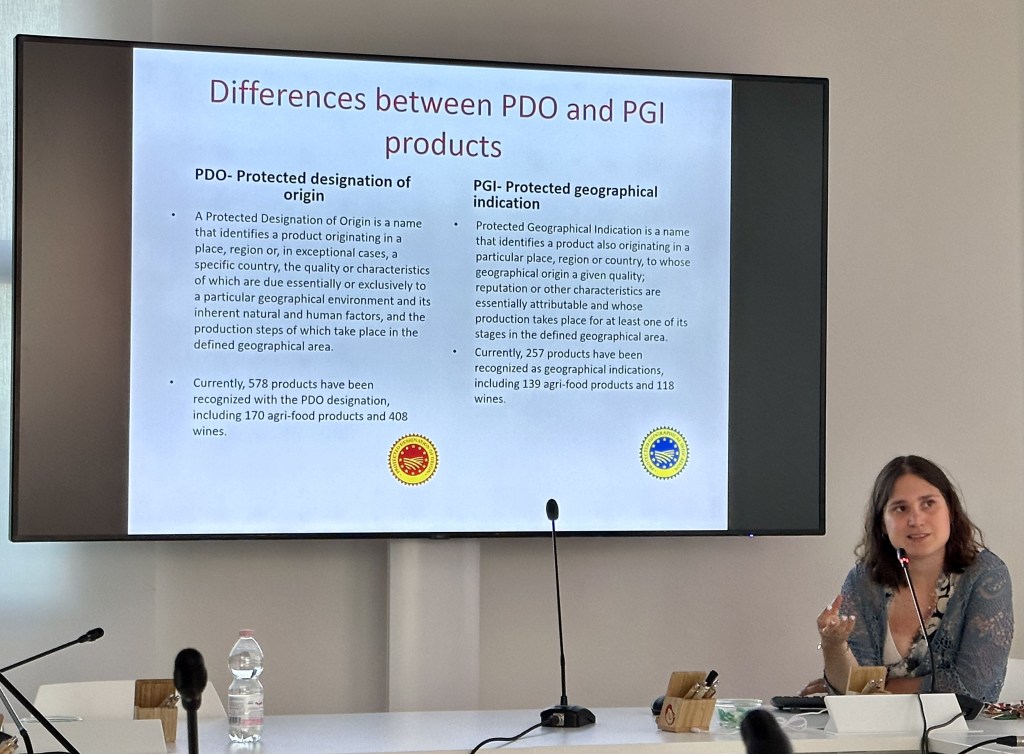
PPM Manager, Signora Eleonora Rosi.
On every learning level the student experience at Piatto Piacere was absolutely excellent. Preceding days for JHU guest lecturers, staff, and students were very challenging due to unusually hot weather conditions. Yet we now found ourselves in a new state-of-the-art presentation classroom that featured comfortable seats, robust air-conditioning, and cell phone chargers, yea! With these creature comforts graciously provided we then received an informative and enthusiastic briefing from the PPM Manager, Signora Eleonora Rosi.
Signora Rosi provided succinct statistical population data (705k region, including 186k in the city) and a brief overview of the region’s non-food businesses. She next provided a vital piece of information – the PPM represents all 24 products which have been designated by the European Economic Community as PDO or PGI. Of special note: An online search quickly confirmed a student rumor that the greater Emilia Romagna region of Italy is the world- leader with 44 PDO/PGI designated products (see Antonelli, 2021).
Signora Rosi first interacted with JHU students by polling us to learn of our favorite PDO and PGI foods and drinks from the Modena region. Signora Rose’s poll questions accompanied with her humorous responses to the student’s replies was a great learning experience.
For the record, the specific PDO and PGI food and drink poll items were; Balsamic Vinegar, Brusche Sour Cherries, Cotechino & Zampone Sausage, Lambrusco Wine (X4), Modena Ham, Parmesan Cheese, and Vignola Cherries. Please note that these items are those featured on the PPM’s excellent bi-lingual [EN/IT] website (see PPM, n.d.).
The PPM’s mission statement was presented early in the lecture. “The Consortia [PPM] exercises protection from the [Italian] Ministry of Agriculture to preserve, promote and improve the territorial marketing strategy for the Modena Chamber of Commerce and Industry” (Rosi, 2023). A critical part of the presentation was information clarifying “The Differences Between PDO and PGI Products” (Rosi, 2023). For me at that point in time the lecture the information from previous lectures, readings, and site visits, fell into place. For the sake of brevity – those info sources being Mr. Lean’s lecture, the Flinzberger assigned reading, the IMAFSF website, and our visit to non-profit Acetaia Communale Balsamic Vinegar location.
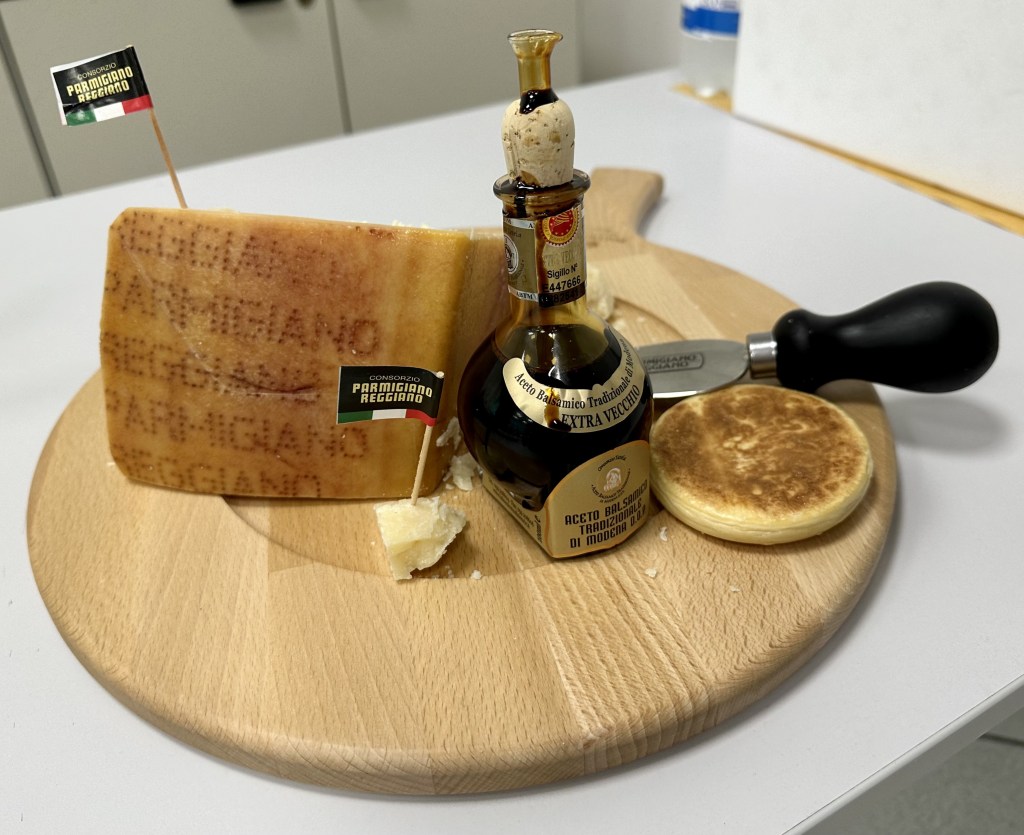
Actual PPM Lunch: Balsamic Vinegar, Tigelle Bread, and Parmesan Cheese.
As our class resettled on the ground floor awaiting a tasty PDO/PGI lunch from the PPM, I quickly learned that all of the students within my range of my hearing, about a third of the class, were discussing the topics that were at the front of my mind. First, how things were now falling into place (that should encourage our professors) and second, many engaging conversations about how strongly the PPM is linked into the region’s cultural heritage. Yes, the PPM has advertising, goes to conventions and trade fairs, etc. But we all unanimously agreed that the PPM’s best efforts are encouraging, organizing and promoting the community festivals, harvest parades, tasting competitions, and similar people intensive experiences. These events are key support.
We agreed the ‘people things’ best ensure food crafts will thrive and get passed onto the following generations. One female classmate was surprised to learn another male student and myself were both interested in the “kids’ plates” territory-wide design competition. Along with the aforementioned activities, the kid’s plates activities are where intangible values get passed on by the tangible experiences, tangible items, tangible symbols, etc.
Just when we thought things couldn’t get any better, we were back in a new state-of-the art, air-conditioned classroom at The University of Modena and Reggio Emilia in Modena. Thank you to Professors Cicone and Padovani, and whomever you persuaded to save us from the heat!!!
And soon appeared a UNIMORE Professor – Dr. Francesca De Canio. Although there is no evidence to support this statement, I’m reasonably certain Dr. De Canio must be related to Signora Rosi of the PPM as she repeatedly had our class engaged in hilarious laughter.
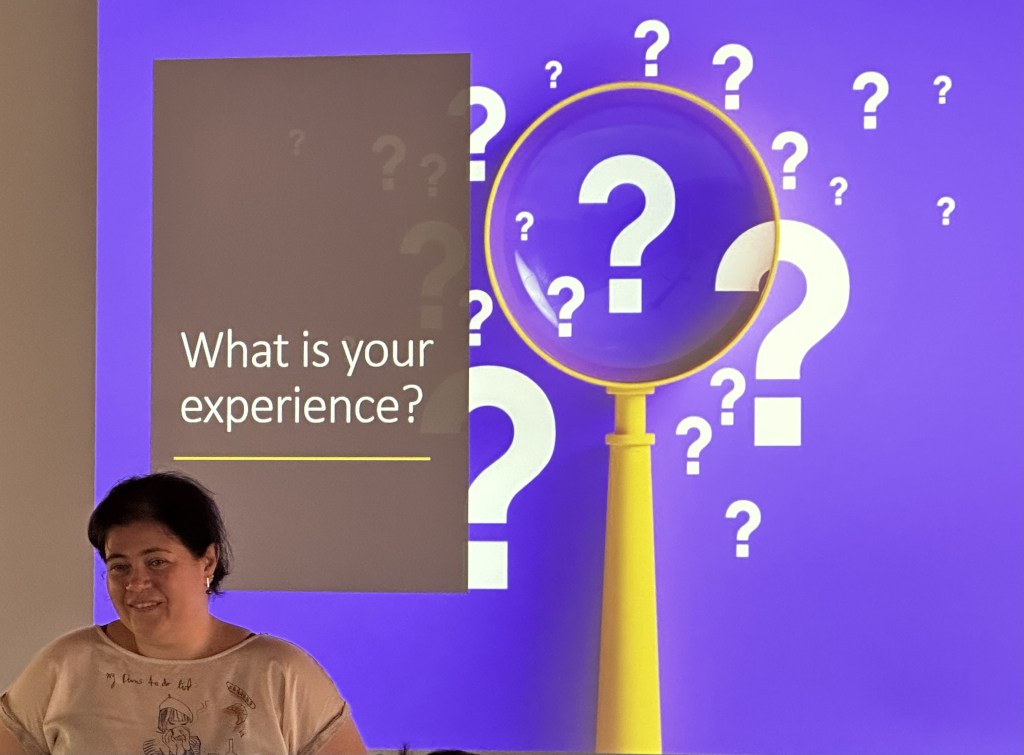
UNIMORE Professor – Dr. Francesca De Canio.
On the serious side, Dr. De Canio briefly discussed her own academic migration through various disciplines, eventually winding up in food tourism. She successfully argued food tourism equates to a tangible territorial experience which creates an intangible territorial memory. She also broke down food tourism into two more definitive sub-components; gastronomic tours and culinary tours. Dr. De Canio also presented the concept that the intangible food heritage resources must receive regional protections or their survival cannot be ensured.
It seemed like an eerily linked coincidence when Dr. De Canio stated that all cultural heritage professionals involved in food heritage must learn to motivate visitors into a personal experience via sound emotional ques. I make this statement because it took me back to the same concept expressed by Signora Rosi, albeit in somewhat less sophisticated, yet equally effective manner.
Dr, De Canio also shared some of her childhood intangible experiences from religious festivals and parades. This generated a great deal of impromptu responses from many JHU classmates. She strongly emphasized t the intangible memory is powerful and long-lasting.
Final thought for the day… in the past and on this day, in the morning with Signora Rosi and duirng the afternoon with Dr. De Canio, I observed a bi-lingual phenomenon. It’s when the enthusiasm and sincerity of the lecturer overcomes most communication deficiencies. That is, the speaker can’t find the best word to express their idea via their second language, yet they have so deeply and readily bonded with the listeners that all of the ideas are still very successfully conveyed.
Not every day in school can be easy and fun, but this one certainly was!
References:
Antonelli, F., 2021. Region Emilia Romagna ranks first in the list of excellence delis (PDO and IGP food products). Emilia Romagna Tour Guide, published 15 April, 2021. https://en.emiliaromagnatourguide.com/post/region-emilia-romagna-ranks-first-in-the-list-of-excellence-delis-pdo-and-igp-food-products
Flinzberger, L. et al, 2022. EU-wide mapping of ‘Protected Designations of Origin’ foodproducts (PDOs) reveals correlations with social-ecological landscapes. Agronomy for Sustainable Development, pp. 42-43. https://link.springer.com/article/10.1007/s13593-022-00778-4
IMAFSF, n.d. Geographical Indications: Would you know more about GIs? Italian Ministry of Agriculture, Food Sovereignty and Forestry, Rome, IT. https://dopigp.politicheagricole.gov.it/en/le-denominazioni
PPM, n.d. Piatto Piacere Modena. Palatipico Modena Srl, Modena, IT. https://www.piaceremodena.it/
Rosi, E., 2023. Lecture, Piacere Modena: Territorio, Tourismo, Ristorazione [EN: Territory, Tourism, Catering], 21 July 2023, Piatto Piacere Modena, Modena, IT.
 Grande Giro di Modena