
July 22nd – The day began about 6 blocks north of campus at the Italian Army’s military academy, the US equivalent of the US Army’s West Point. Il Accademia Militare Di Modena was founded in 1678 and is located in the historic Ducale Palace. In addition to information which can be learned from the academy and city tourism websites (see References) our guides offered many bits of information to help us gain a better understanding of many things, especially pertaining to the architectural styles.
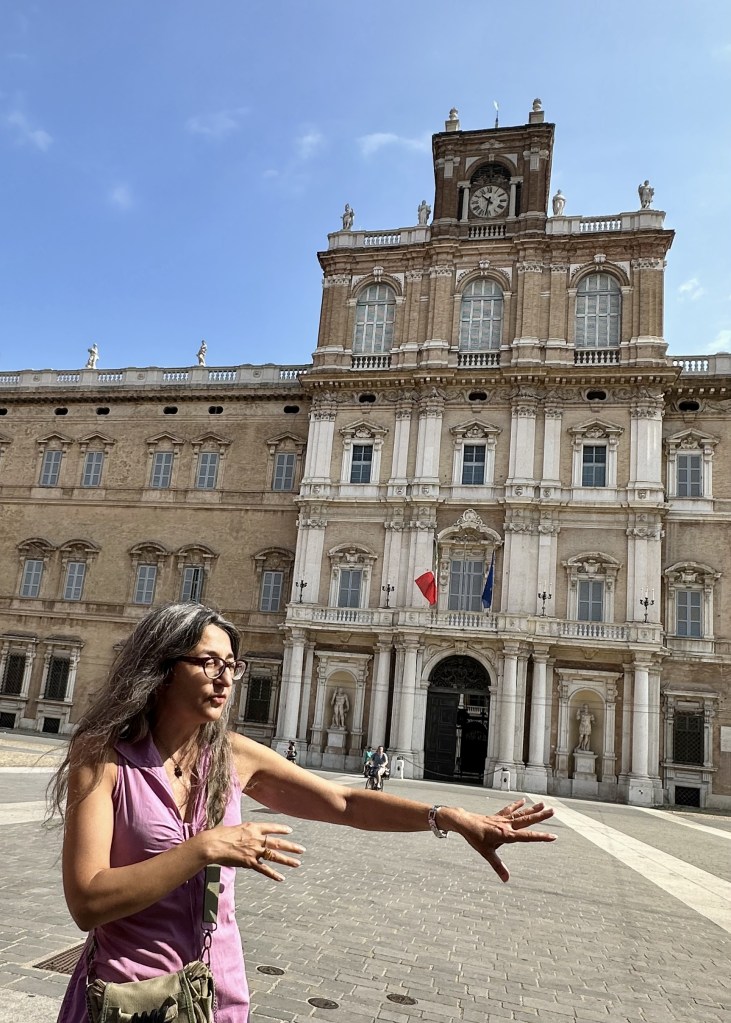
Signora Melina Bizzarri of the Modena Tourism Cooperative.
Our tour was conducted by Signora Melina Bizzarri of the Modena Tourism Cooperative and Lieutenant Colonel Luigi Di Aria of the Italian Army. If Lt. Col. Di Aria declared his position within the institution, I did not hear him. Most certainly his level of rank inherently places him in a high-middle level or a senior level leadership position within the military institution.
Many questions about Italian military service and the nature of the training at the academy were fielded to Lt. Col Di Aria. He confirmed that conscription (the draft) ended sometime in the late 1980s or early 1990s and that women became eligible to attend the academy in the year 2000 (or closely there abouts). He also briefly discussed the annual “duramento” for the allegiance and commissioning pledge of graduates and the simultaneous arrival of new cadets and the transition from the lower class into the upper class of the cadet corps.
Early during the inside tour one of the first comments made pertained to vertical cuts made from ground level to roof top through all floor levels on what appeared to be nearly every wall. These cuts were made in response to geological studies after the serious 1986 earthquake(s). The purpose of the cuts is to isolate sections of the palace which lay atop differing types and varying strengths of stone foundations and underlying soils with ever changing levels of water saturation. These seismic threat responses are very necessary to minimize hazards to the structure, its contents, and its residents/visitors. Increasingly, cultural heritage professionals are involved in crisis management planning to help define and prioritize all sorts of heritage assets.
Also, along architectural lines Signora Bizzarri pointed out from the plaza that the stone edifices on the center, east and west sides were constructed from different materials. This was due to the varying availability and cost of materials during several different periods of political unrest. She also pointed out major changes such as Saint Dominic’s cathedral on the west side. It was reoriented from east-west to north-south for expansion of the Ducal Palace. She also commented about 3 major canals and the area wetlands being filled in.

The Courtyard of the Ducal Palace.
At least one other student and myself commented to a couple others that these ‘stories’ about the building were in large part quite similar to what Architectural Professor Eva Coisson explained to our class. That is, all buildings to varying degrees present history about themselves, that’s essential when historic documentation is unverifiable or lost.

Ceasar.
Lt. Col. Di Aria pointed out the fact that in the recurring arch-and-pillar design all three types of Classical Greek columns (Corinthian, Doric, and Ionic) are present in the Ducal Palace structure. Various aspects of paintings and sculpture were addressed and other than the large portraits of multiple generations of royalty most artwork pertained to military genre. A number of the rooms contained many types of military memorabilia including flags, medals, portraits, and uniforms. An array of flags from different eras are displayed, including the families Estense and Savoy, plus the Napoleonic. An interesting comment from the colonel pertained to “The Blue Sash” of special distinction with the color symbolizing the color of the inside of the cloak of the Virgin Mary. Certainly, this is a very foreign concept to myself which if properly researched could prove quite interesting.
Several minutes were spent inside the grand ballroom as we learned about one of the dukes in a major financial crisis who sold artwork to entities in Dresden to raise needed cash. In another instance, after a major fire, frescos were removed for protection and restoration.
In all, the Ducal Palace is a wonderful place that is chock full of many tangible forms of cultural heritage from the military and from royalty. However, its cultural heritage is not only present from what ‘things’ are or were present. If one thinks, the intangible heritage is just as much present is due to the historic events occurring there for over four centuries.
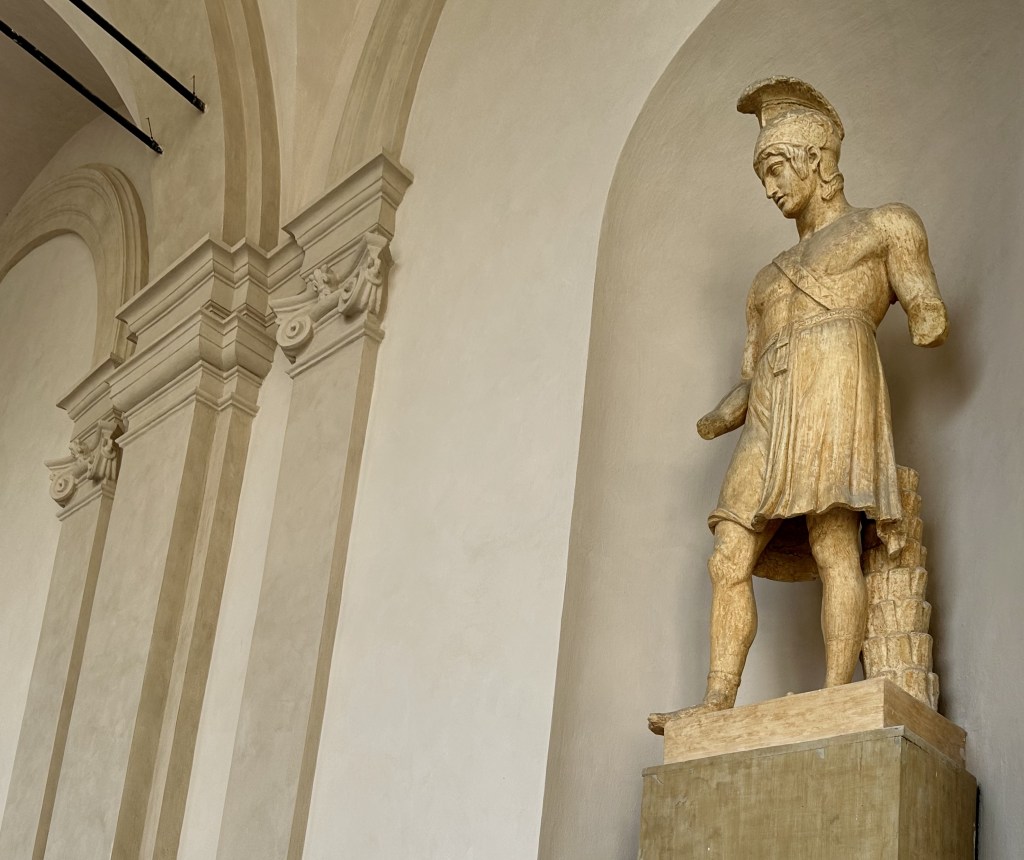
Sculpture of an unknown Roman soldier.
Physically the brief walk to the ex Albergo Diurno is only a few hundred meters from the Ducal Palace. Psychologically the ex-Albergo Diurno is about one million meters from the Ducal Palace. To be fair, “what’s there is there” and the ex-Albergo Diurno is there in Modena. It’s there along with the beloved ancient cathedrals, city gates, and a mighty leaning tower.
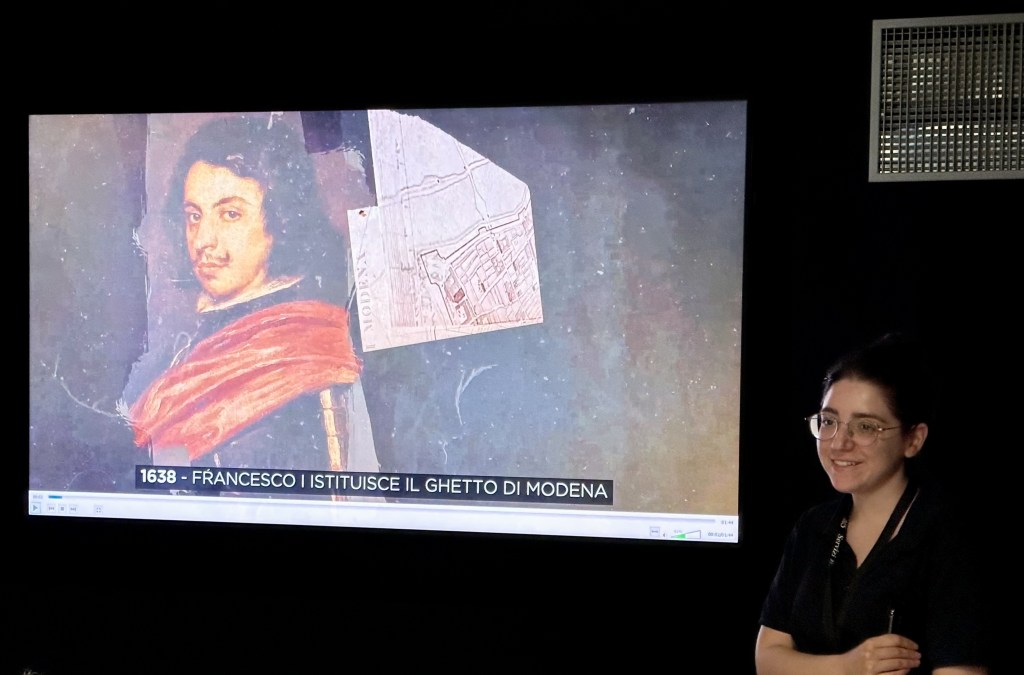
Docent Maria Louise.
The “ex” is something of an art-deco and/or Scandinavian minimalist styled day-use hotel from the early 20th Century. When it was built many ancient artifacts and an unspecified number human remains were unearthed. By the 1970s it went into disuse and was closed. In recent years it was renovated, repaired and re-opened as a mini-museum and city tourist briefing spot. The city’s tourist information website (see References) provides both an informative description and well-described history.
From my perspective as a cultural heritage management student, I am very curious about how the decision to carry out the repair/restoration came about. Especially, the actual costs. Plus, how was the cost to benefit analysis carried out, what were the key criteria?

JHU Students Mezmerised by Flying Drone Duoma Video at “the ex.”
A number of questions were put to the docent, Maria Louise. It was evident she was not accustomed to or trained for deeper questions from graduate students. She’s there for the average tourist. To her credit she was enthusiastic, pleasant, and did the best she could.
References:
AMDM, 2023. Accademia Militare Di Modena, History and Traditions Webpage. Esercito Italiano [Army of Italy], Modena, IT.https://www.esercito.difesa.it/en/organization/The-Chief-of-General-Staff-of-the-Army/Training-Specialization-and-Doctrine-Command/Training-Command-and-Application-School-of-the-Army/Military-Academy/Pagine/History-and-traditions.aspx
Visit Modena, n.d. DOGE’S PALACE – MILITARY ACADEMY, Modena Official Tourist Information Site, Modena, IT. https://www.visitmodena.it/it/scopri-modena/arte-e-cultura/palazzi-storici-e-castelli/palazzo-ducale-accademia-militare
Visit Modena, n.d. DISCOVER THE “EX ALBERGO DIURNO” (THE FORMER DAY-USE HOTEL), Modena Official Tourist Information Site, Modena, IT.https://www.visitmodena.it/en/activities/art-and-culture-experiences/ex-albergo-diurno
 Grande Giro di Modena