
July 23rd – The day began with a mini-bus trip to Mount Pietra di Bismantova. The mount is an inselberg (see Science Drill, 2023) which protrudes very steep, 980 ft. above the adjacent landscape. Our class was accompanied by Dottores Stephano Lugli (Geologist) and Paola Zannini (Chemist). From the parking lot several JHU students commented that the mount looks like a shorter version of Devil’s Tower in Wyoming. Dr. Lugli confirmed that the students were on the right track – as far as the type of rock formation. However, he also noted that Mount PiB is sedimentary rock, specifically Calcarenite limestone, and Devil’s Tower is a much harder igneous rock.
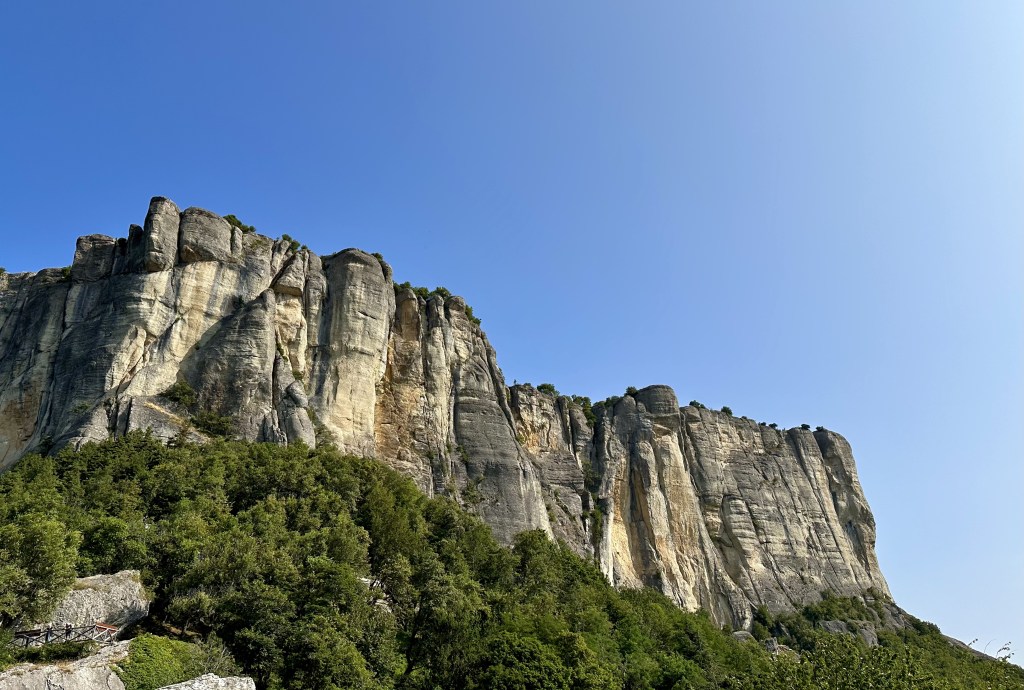
No, this isn’t Devils Tower in Wyoming…
Many students were anxious to begin the upward hike immediately. However, Dr. Lugli first presented a geological overview (both space & time) at the large and well-designed interpretive signs at the beginning of the Mount Pietra di Bismantova trail. He discussed the clash of the African tectonic plate sliding into and mostly under (subduction process) the Eurasian tectonic plate. This of course is the causal effect for the earthquakes in Italy and elsewhere along the two plates’ edges. The clash of continental plates explains how the unusual geological formations came into being, plus what will happen in the future.
Dr. Lugli’s trailhead lecture also included the geological time line based upon the fossil record of the sedimentary rock; that is depth, sequential layers, types of creatures found. Did I forget anything?
The professor noted that we’ve only got 50 million years before Africa lands right-smack-on-top where we were standing (and a little bit more area too, like the Mediterranean and Adriatic Seas, so we set out on our mountain hike right away so we wouldn’t get squished.
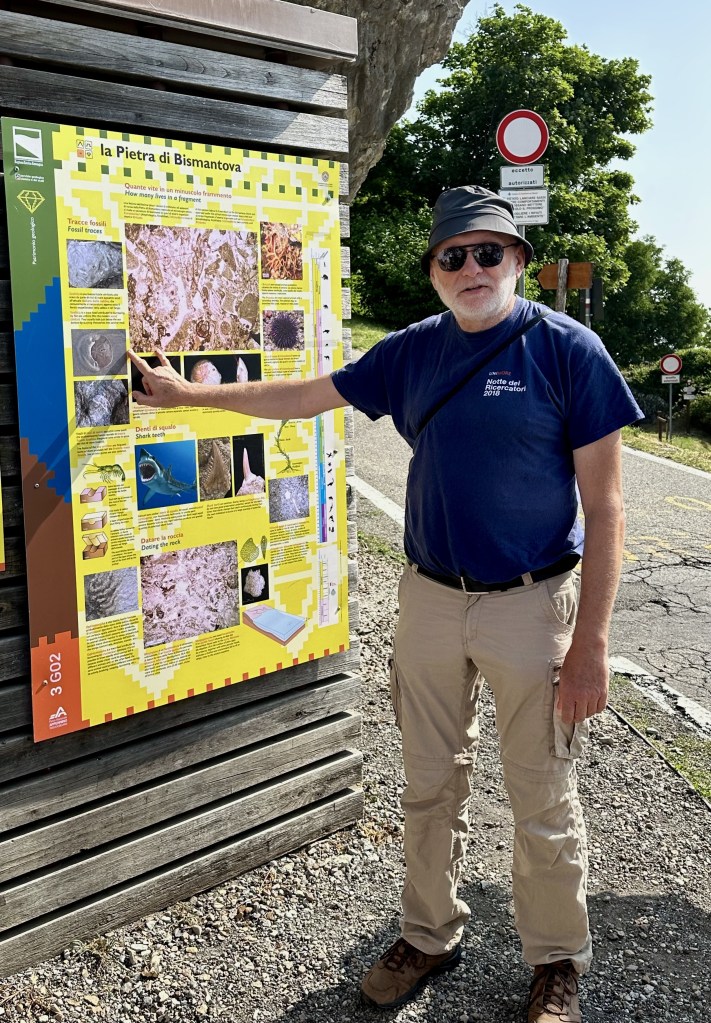
If you kids don’t listen – we’re not going up this mountain or to McDonalds!
Next, about 100 meters up the trail is refreshment for both the body and the soul at the Rifugio della Pietra restaurant the Eremo (Hermitage) di Bismantova chapel. I was happy to see and utilize both refreshment opportunities. I thought of previous discussions in this course and many previous courses about the influence of geology upon the lives of people both past and present. At this little rest stop and all around the region this geology reigns.
During our short uphill refreshment stop Dr. Lugli explained how the top of the mount is Calcarenite limestone (as mentioned earlier) yet below, its base it rests upon inherently unstable semi-hardened clay. Because the soft clay erodes much more quickly than the harder limestone, all the edges of the mount’s base are inevitably subject to rockfalls.
Also, during this stop Dr. Lugli (non-lecture time) mentioned to myself and a handful of close by students how many rocks of various sizes have broken away and fallen near and sometimes on the chapel. Once a huge hunk of rock either struck or almost struck the local priest’s automobile. This incident resulted in the design, manufacturing, and installation of steel retaining bars and mesh cable nets above the chapel area to protect both people and property.

If this chapel was in Arizona it would be named the Falling Rock Church…
On the way down the mount, I learned that Dr. Lugli (or should I say Dr. Anonymous?) was a key person involved with the chapel’s falling rock safety project. My cluster of hikers didn’t reach the mount’s peak, we were about 100-150 lower. And the altitude reading from the compass feature on my cellphone indicated 3,400 ft. elevation.
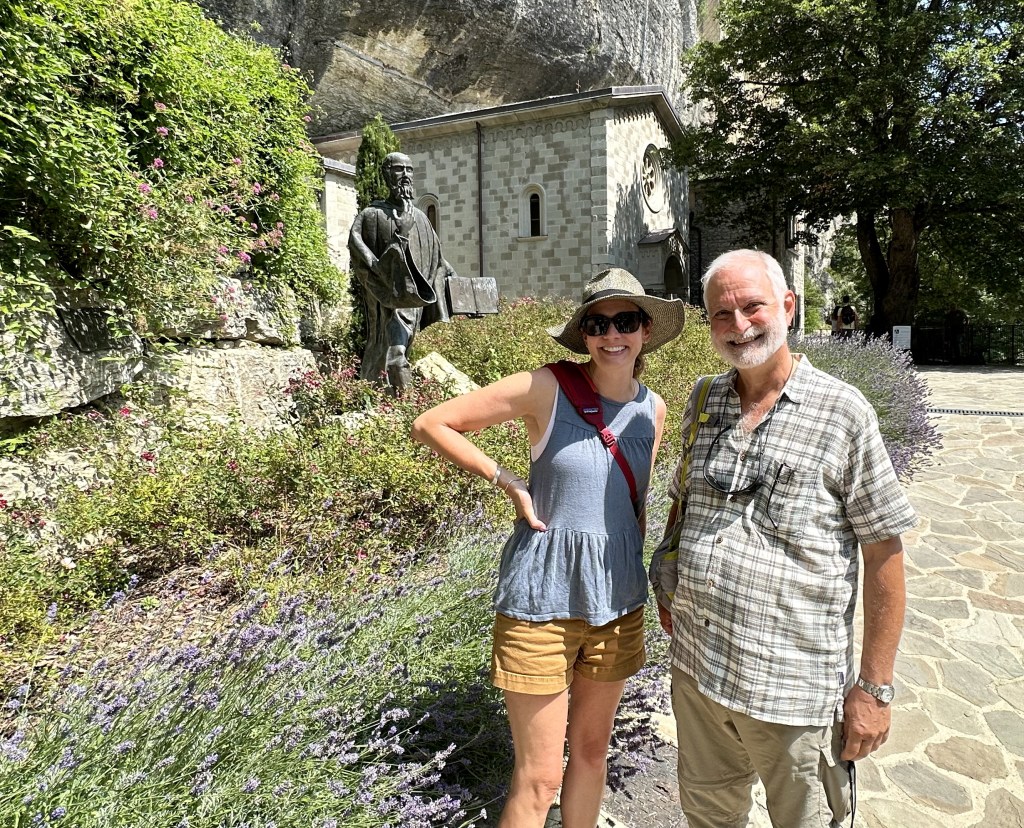
Dr’s Chicone and Zannini – Happy because the got back down safely???
During the mountain trek Dr. Lugli pointed out a number of geological features and he pointed out many three-dimensional graffiti rock carvings, which were mostly serpent figures. Early on we stopped to view an unusual stratified limestone formation of many horizontal layers which that reversed direction due to changing tides and/or uplifts, etc.

Creative serpentine geo-vandalism atop the mount…
Everyone in our group made it up and down Mount PiB safely and upon completion all enjoyed a great big Italian lunch nearby. Observation: On our way down we saw many families, often with small children, coming up. That’s encouraging. I’m unaware of park visitor trends in Italy, but in the US the trend for visitation is downward for young people.
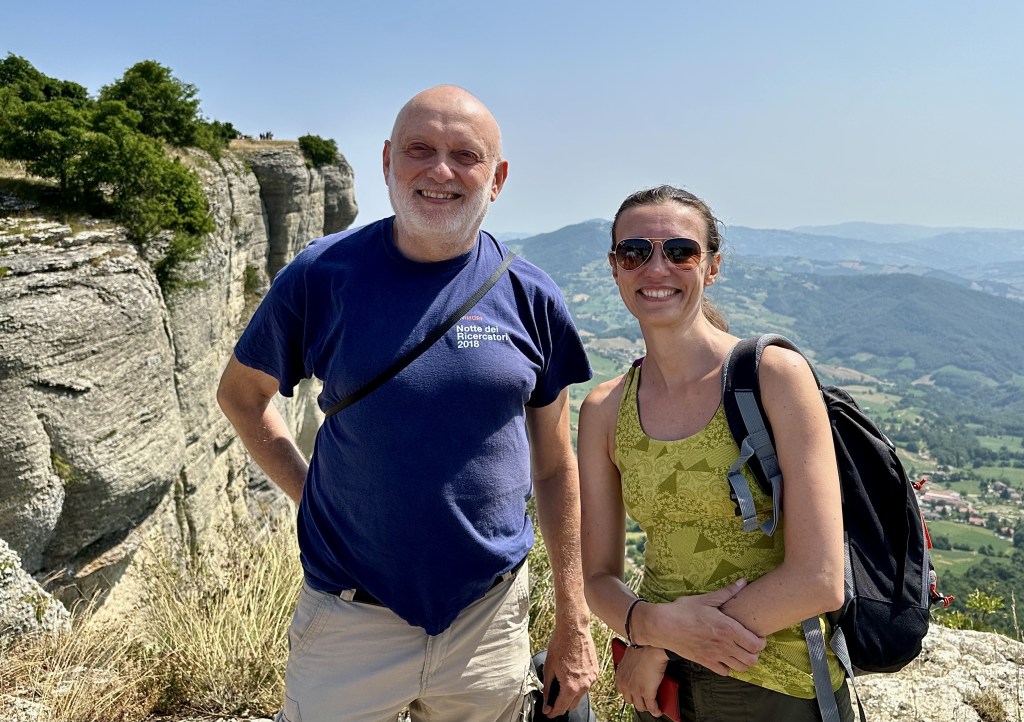
Dr’s Lugli and Padovani – Happy because they’re on the top of the world!
We next traveled down into the Secchia River Valley for three brief geological visits.
First, across the river valley we viewed a series of drastically eroded mountains whose cross-sectional layers were fully visible. The mountains displayed extremely convoluted, twisting layers of clay, gypsum and other rock or soil which I can’t remember. Dr. Lugli explained that the gypsum deposits were created during the Triassic geological period, roughly 200 million years ago. He also repeated an earlier statement on how the vast amount of clay in the region is a primal factor for mudslides, rockslides and rockfalls. The agricultural and commercial uses of gypsum were discussed along with the fact that business entities sought to open mines in the area but their efforts were thwarted.
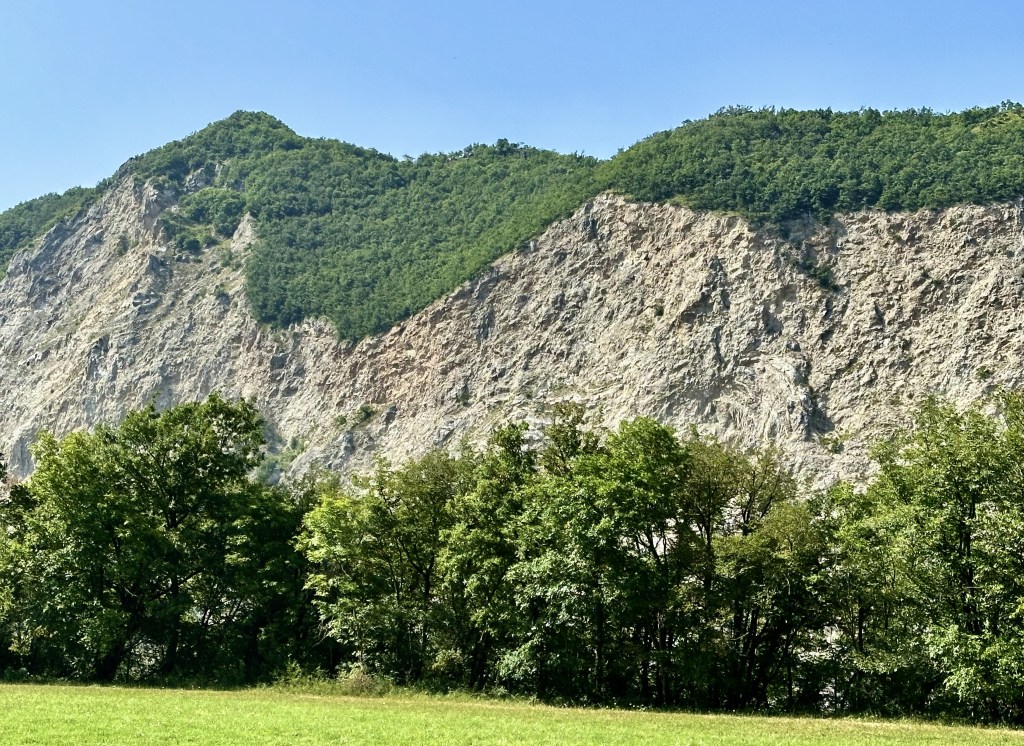
Please stay back from the edge…
Once we got back a few more thoughts about the gypsum came to mind. Primarily, who were the decision makers and the stakeholders in the proposed gypsum mine(s)? How close did the proponents come to achieving their goal? Did the opponents (including Dr. Lugli?) propose a reasonable compromise? For example, “There are significant gypsum deposits 200 km to the northwest and mining operations there would not interfere with this much more significant landscape.” I say this because the world needs gypsum for agricultural and industrial purposes so it needs to be mined somewhere – but not just anywhere. Many environmentalists have an “all-or-nothing” mindset regarding commercial activities. That type of world view is a recipe for conflict rather than communication and negotiation.
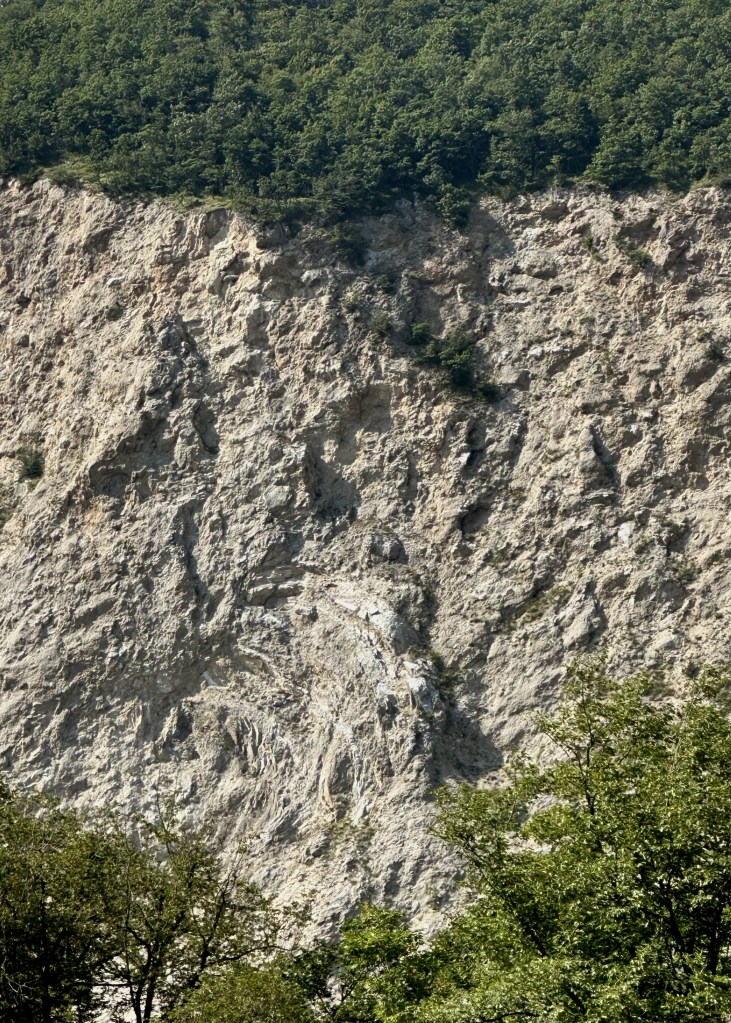
Twisted Gypsum – No that’s not a new gelato flavor…
Second, we hiked out of the riverside meadow up through the forest to view a cave entrance across a deep ravine. On the trail Dr. Lugli recently found a black crystal (but its name I cannot recall) that forms over thousands of years inside gypsum deposits. All looked from some and three students found one each. However, Italian natural resource laws require putting them back or to surrender them to an agency of the Italian federal government.
When the human memory fails – get cracking. I struck gold, well – I really struck quartz, black quartz. It popped right up on a technical paper on this very crystal in the Val Secchia. The paper’s Abstract states “the black color is linked to the presence of disordered graphite inclusions” (Caucia, 2022). I’ll have to see if Dr. Lugli has read this tech article. From the paper figure 7 b appears below.
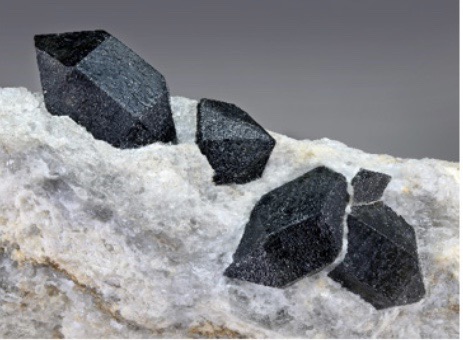
Black Quartz Crystals from the Val Secchia (see Caucia, 2022).
Finally, we travelled to the Salt Springs (Regional?) Park. We learned that the Italian government applied for UNESCO WHS status in 2018, primarily based upon it being a unique karst (see UNESCO, 2018). Drs. Lugli and Zannini expressed their hopes for WHS inscription and mentioned a great number of features. Because the caves are formed from soft geologic materials old caves recurringly collapse and new caves are always forming.
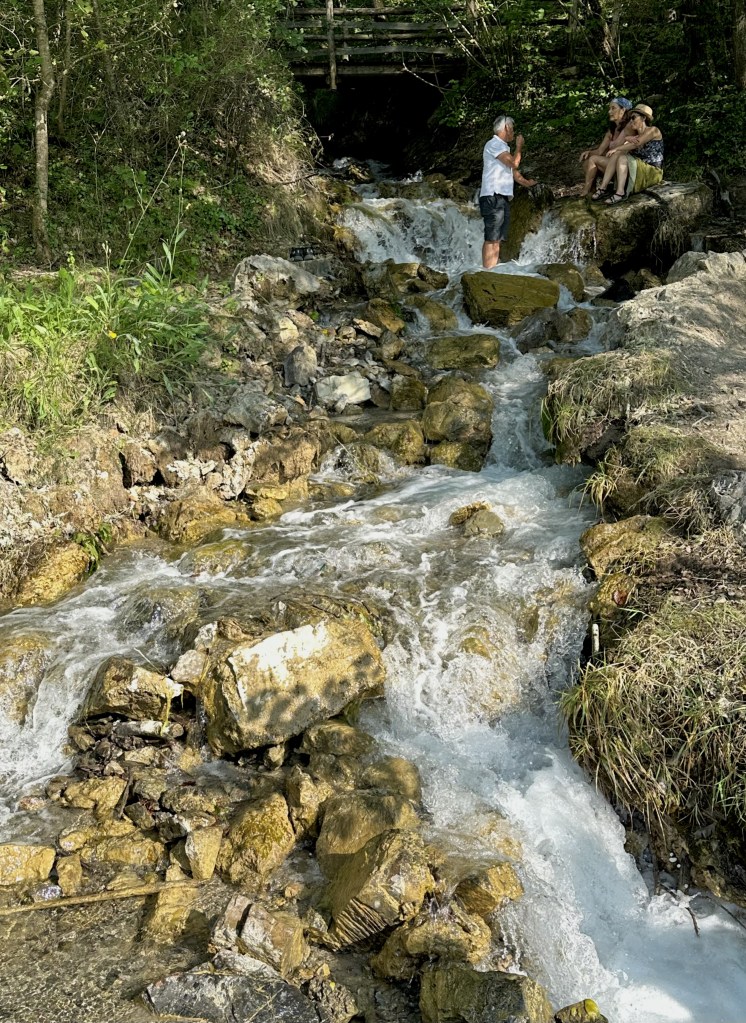
Here’s a good portion of those 500 Liters per second…
During a UNESCO official’s visit to the Salt Springs Park in November 2022 there was a large rock and soil collapse on the immediate mountainside. Many people were distraught, believing that event would lead UNESCO officials to reject the application for WHS inscription. Fortunately, the UNESCO official(s) understood the non-static nature of the soft-karst geology so there was really no need to fear. Other information provided to us was the springs at the park collectively have a 500 liter per minute outflow of salt water (common salt, sodium chloride) and a static year-round temperature of 9 degrees C (42 F).
Through the trip there were multiple side-bar conversations about the rapidly increasing mean annual temperature of the region. There have been numerous Italian television programs on this topic and during one I was able to see credits for one source, an online article (see Hughes 2022). This article discusses the long-term negative effects of water shortages in the Po River Valley, especially for agriculture. One problem already facing farming is overdraw of the valley’s aquifer which is now causing salt water incursions.
References:
Caucia, F., et al, 2022. Black Quartz from the Burano Formation (Val Secchia, Italy):An Unusual Gem. Minerals 2022, Vo. 12, Iss. 11, 1449; Earth and Environmental Sciences Department, University of Pavia, IT. Multidisciplinary Digital Publishing Institute, Basel, SW. https://www.mdpi.com/2075-163X/12/11/1449
Hughes, R., 2022. The longest river in Italy is drying up. What does this mean for those who rely on it for food? Online article, 20 June 2022, Euro News Green. https://www.euronews.com/green/2022/05/14/the-longest-river-in-italy-is-drying-up-what-does-this-mean-for-those-who-rely-on-it-for-f
Science Drill, 2023. Monadnock or Inselberg Definition, Formation, and Examples, Science Drill Website. Last Updated 24 July 2023. https://sciencedrill.com/inselberg-or-monadnock/
UNESCO, 2018. Evaporite karst and caves of Emilia Romagna Region – Description. World Heritage Convention, Paris, FR. https://whc.unesco.org/en/tentativelists/6317/
Wikipedia, 2022. Pietra di Bismantova, Wikipedia Article, Last Updated 13 April 2022. https://en.wikipedia.org/wiki/Pietra_di_Bismantova
 Grande Giro di Modena