
July 24th – The day began with an introductory lecture about the University’s 1786 Estense Gemma Museum by its Director, Dottore Melina Bertachinni. She first spoke about the museum came about. It began in 1786 when Giuseppe Maria Fogliani, the bishop of Modena, donated his personal collection. In 1814 a brother of Duke Francesco de Censa of Modena made a major contribution to the collection. Dr. Bertachinni spoke in general terms about recurring patterns of political upheaval surrounding the Estes family which impacted the collection. Major parts of it were dispersed for a number of reasons – with financial pressures and acts of war being the worst; many collection items were lost forever.
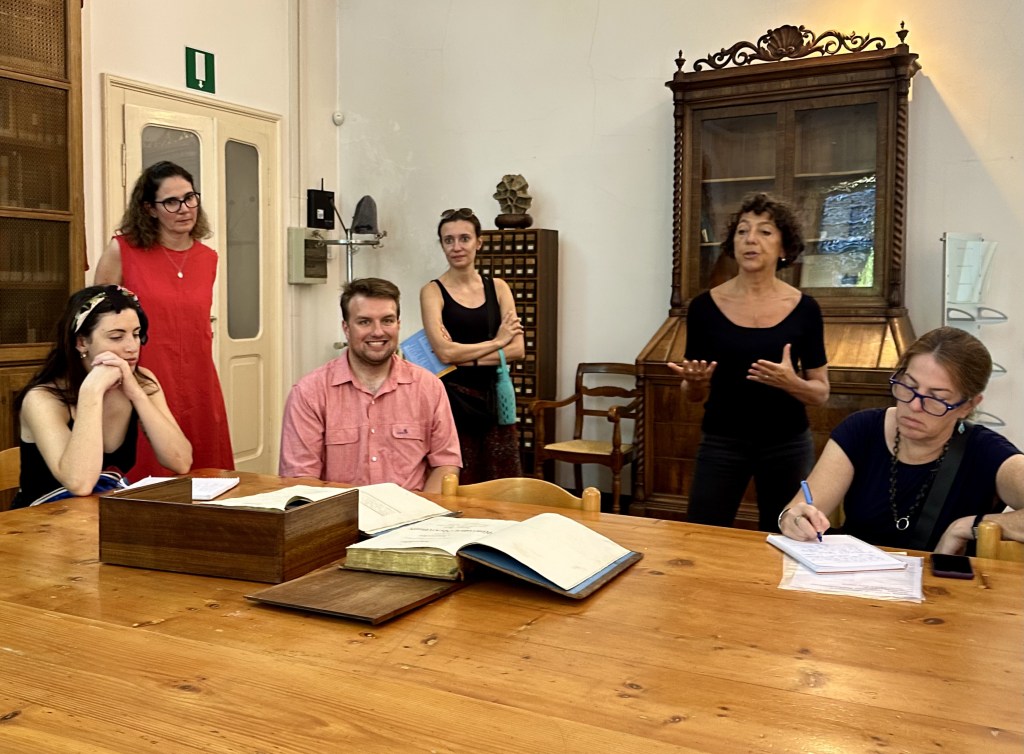
Elijah’s 1799 Alchemy Book Is 224 Years Overdue In The Library!
Hearing the collection’s war losses is no surprise to JHU’s Cultural Heritage Management and Museum Studies students. Our training includes a number of readings on the 1954 Hague Convention (see ICRC, 2010). Wars take heavy tolls on heritage, first from the victim’s tangible losses and second from the victim’s intangibles losses. The precious lost tangible “things” are directly related to how war victim’s undergo secondary stress through their intangible feelings for and memories of the lost things whatever they might have been.
Dr. Bertachinni surprised us when she brought out a large 1799 bound volume created by a German alchemist. It came with many other materials (over 300 items) from the de Censa family bulk donation in 1814. The volume has something to do with ancient Alchemy and is written in German which is no surprise, the volume having come from the Austrian empire.
We followed the Dr. around the room as she introduced the collections therein. But they don’t stop there, we’ve been walking every day past parts of many collections in cases along the halls en route to class. Dr. Bertachinni takes great pride in the 1766 meteorite which is mentioned prominently in the city visitor’s bureau webpage for the museum (see Visit Modena, n.d.). And the museum has its own university website (see UNIMORE, 2023).

“The famous meteorite that fell in Albareto di Modena in 1766.”
Amidst the old display cases is one futuristically styled called “No-Kryptonite.” It’s marketing effort that’s aimed at motivating interest in geology for children and young adults. “NOT JUST KRYPTONITE! Minerals, gems and heroes in comics and manga – festival Filosofia 2022” is the webpage and sign banner.

Displays – Old and New…
Plus “The exhibition itinerary explores the role that gems and minerals play in the stories of comic book and manga heroes and in the development of their tireless fight against injustice, from Sailor Moon to Superman, from Ironman to Black Panther” is the webpage description (see UNIMORE, 2023).

Look Out – It’s Glowing!
One of the last topics discussed by Dr. Bertachinni was their display many of rare earth elements and minerals. Theses are required for the manufacture of high-tech electronics and electric vehicle batteries. Of course, these elements and minerals are not evenly distributed across the world. She touched on the topic that there’s a number of concerns about military and political implications to acquire and control rare earth minerals.
Dr. Bertachinni’s comments piqued memories of my special military tour of duty in several East African nations during the Summer of 2010. At that time, I saw dozens of capital infrastructure projects in a half-dozen nations. And they were all businesses owned wholly or with a controlling interest by entities from the People’s Republic of China. In Uganda alone, the Chinese have controlling interest in the national power grid, the leading cell phone company, and a new hydro-electric dam complex being built on the Nile. Plus, Chinese businesses are establishing rare earth mines within many African Rift countries. If I had the time, it would be interesting to see what China is trying to purchase here in Italy.
We next visited the UNIMORE Museum of Zoology and Comparative Anatomy. In a similar manner to the GEMMA, we received a walking lecture from the Director, Dr. Andrae Gamarelli. He conveyed a great deal of information to us but this will be an attempt to review what’s closely related the cultural heritage interests and issues.

Scarry Specimen #1.
Dr. Gamarelli spoke briefly about how this diverse collection flourished in the 17th and 18th centuries but floundered in the 19th. Of note he was cognizant of what things would be of concern or interest to cultural heritage students and professionals. Dr. Gamarelli explained two key reasons for the angry looking and often mis-shaped taxidermy. First, the mindset in past centuries was that all animals were wild and should be depicted that wild as a sign of humans being in charge of wild nature. Second, the taxidermists of earlier centuries only received pelts as carcasses could not be transported great distances with refrigeration, etc. Thus, there was a lot of reverse engineering [student’s description] to reconstruct the animals from oral statements, often poor drawings, no photography, and no skeletons.
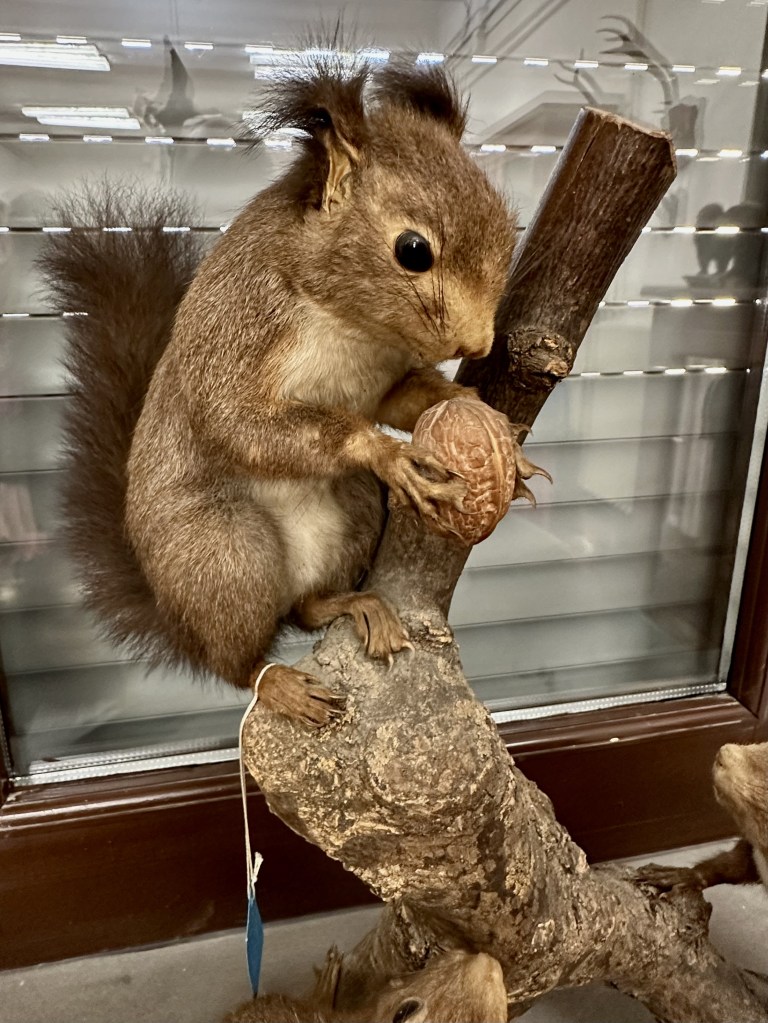
Scary Specimen #2.
Dr. Gamarelli also noted that the order in what creatures were presented (beginning with mammals) in centuries past was along those the same philosophical lines of humans (and things most like them) were preeminent over the “lesser” orders, such as fish. There was back and forth discussion about the museum’s funding, municipal or from the university, but due to the heat I had to walk away to a window and never got the financial answer.
The collection suffered drastic damage from an 1883 wind-storm that damaged roof and was accompanied very heavy rainfall. Ironically, it was the big shark from Italian waters that received tremendous damage, however it was eventually restored. We were surprised to learn that the museum’s rhino had been the victim of professional rhino horn thieves.
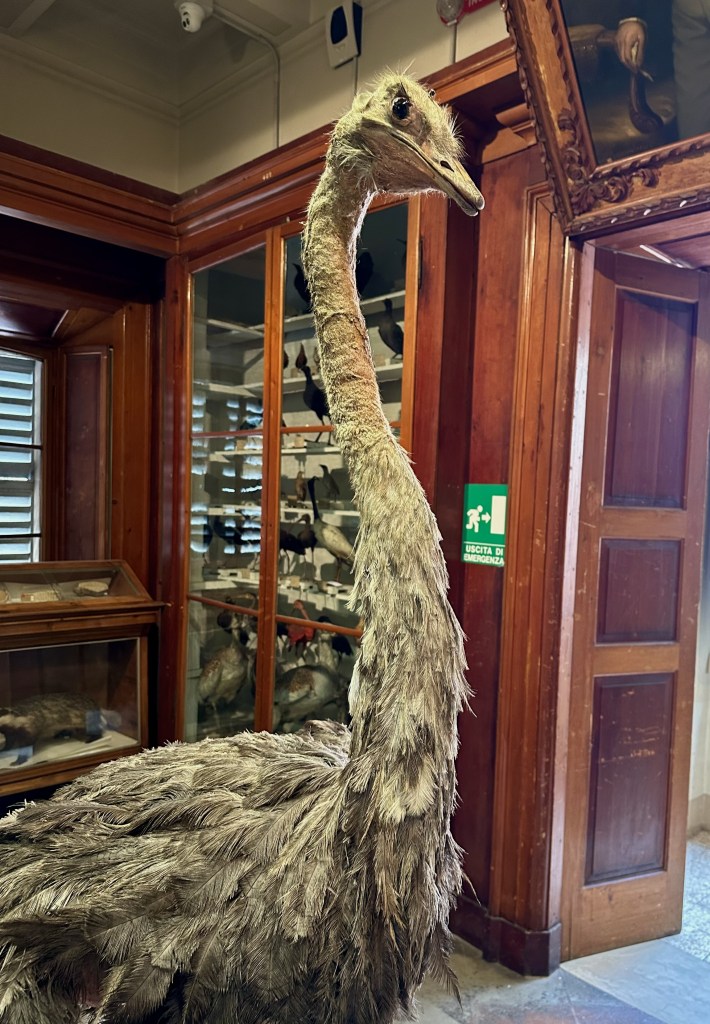
Scary Specimen #3.
The two last topics of very definite concern to cultural heritage students and professionals. A number of haz-mat concerns. Loads of antique glass – not safety glass in every cabinet and display. Plus, chemicals used in the taxidermy process; formaldehyde and others?
One need not be a certified archivist to cringe when seeing large documents, some several centuries old, laying around on table-tops and on top file cabinets. Some were hand-made artwork and some obviously had already suffered from poor handling and/or poor storage.
The last tour of the day was way atop the old East Tower of the Ducal Palace. A small part of the site remains in use as an official weather station office and the bulk of the upstairs is a well-preserved astronomical laboratory. Reportedly, the weather station has a very special distinction, as the oldest, continuously recording weather station in the world. A quick check indicated that a number of weather stations make that claim.

The Tower of Astronomical Power…
We were met by Signor Luca Lobroso, Metrological Technician for ilMeteo. He maintains this and other weather station sites in this region (see NESA, 2022). The tower’s architecture and its contents are very interesting. The old metrological instruments were interesting but my perception was most students were more interested in the telescopes.
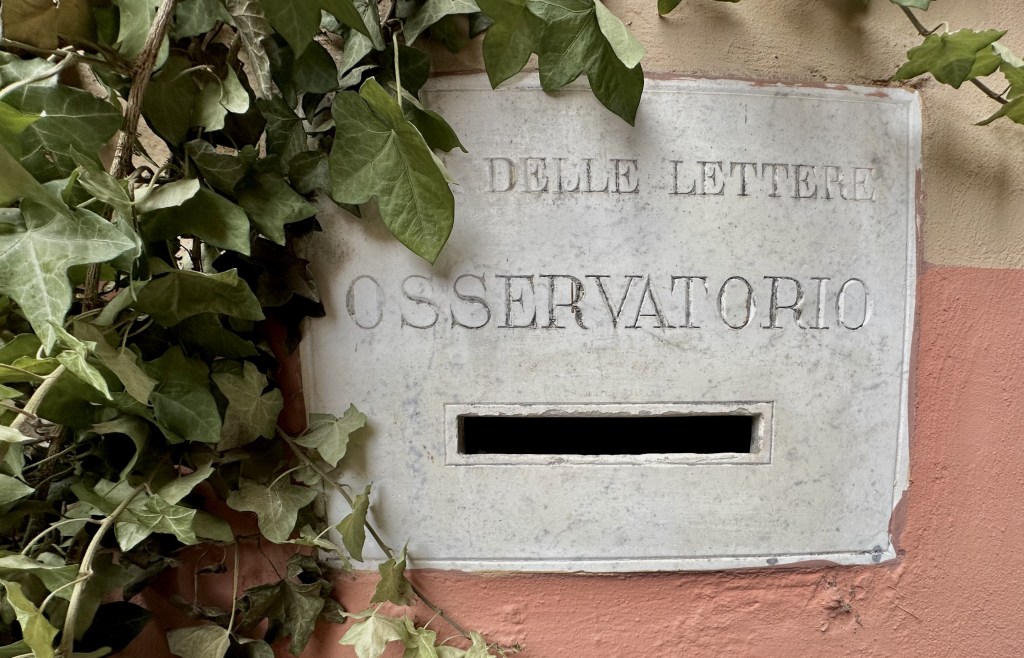
Signor Lombroso has a good recollection of historical facts as he was able to quote numerous important names and dates. I had difficulty understanding his pronunciation of most names but that is not a problem as the University’s web site provides a good history. Of note, the fact that this astronomical observatory was established in 1826 (197-years).

Red Vertical Bars and Hand Fans – Too Hot for Everybody!
From a cultural heritage point of view there are great number of tangible things such as the tower, the architecture its superstructure, and many scientific artifacts of astronomy. These things combined with its own history and the area history fosters the intangible emotions and memories that visitors can will take away with them after their visit. And not to overlook the view of the city and especially the Duomo and the Ghirlandina.
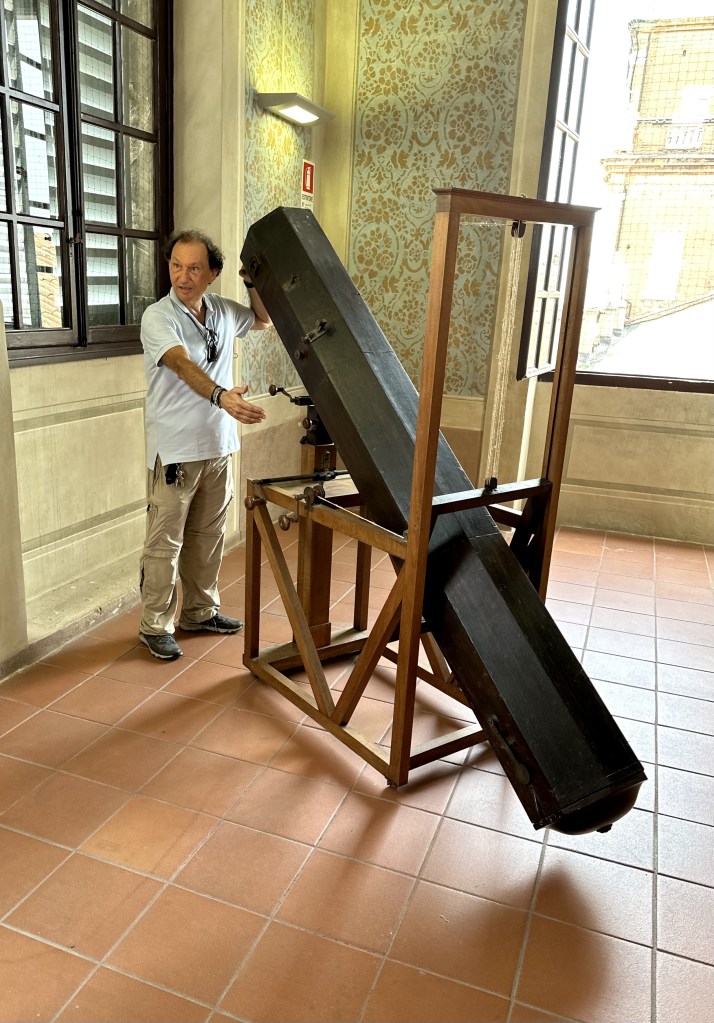
No Kids, It’s A Telescope – Not A Cannon…
There were a number of things mentioned by Signor Lombroso that struck me as interesting. First that it was an astronomer recording the daily weather. But stopping to think, that makes sense. Learned people were multi-taskers and had solid math skills and metrology hadn’t developed into its own discipline. Taking that idea forward a couple of hundred years and crossing over the oceans is one comparison.
I was reading about the history of the US Army Corps of Engineers and how graduates of West Point might be joined to the USACE upon graduation. Many engineers were working on the Ohio and Erie Canal when it was being built in Ohio between 1825 to 1832. But I discovered that back then there were no civil engineers, structural engineers, mechanical engineers, etc. One was an engineer based upon receiving a classical education in mathematics and the sciences. In the US such specializations did not come into play until the end of the Civil War era. So, an astronomer recording weather readings two hundred years ago isn’t unusual after all.
Signor Lombroso’s comments about someone painting the marble column and covering up hundreds of years of notes is the epitome of a cultural heritage professional’s nightmare. I also feel that the celestial telescope is the most significant artifact on the premises because of the users’ development of data tables for trans-oceanic ship’s celestial navigation.

Who Painted That Marble Column?
References:
GEMMA, 2023. Museo Mineralogico e Geologico Estense, Universita Delgi Studi di Modena e Reggio Emilia [AKA UNIMORE], Modena, IT.
ICRC, 2010. Protection of cultural property in the event of armed conflict: 29-10-2010 Overview. International Committee of the Red Cross, Geneva, SW. https://www.icrc.org/en/doc/war-and-law/conduct-hostilities/cultural-property/overview-cultural-property.htm
Lombroso, L., 2023. Guided tour of the Modena Astronomy Laboratory in the old East Tower of the Ducal Palace, 24 July 2023, Signor Luca Lobroso, Metrological Technician for ilMeteo Srl, subsidiary of Gruppo Mefin Srl, Givoletto, Turin, IT. www.ilmeteo.it
Museum of Astronomy and Geophysics Observatory – Visit Modena Webpage, Modena, IT. Official Tourist Information Site of Modena, IT. https://www.visitmodena.it/en/discover-modena/art-and-culture/museums-archives-and-libraries/modena/university-museum-museum-of-astronomy-and-geophysics
Museum of Zoology and Comparative Anatomy – Visit Modena Webpage, Modena, IT. Official Tourist Information Site of Modena, IT.
NESA, 2022. Italy – Supply and maintenance of the UNIMORE weather station network,
NESA Srl, Vidor, IT. https://www.nesasrl.eu/en/case-history/italy-supply-and-maintenance-of-the-unimore-weather-station-network/
Osservatorio Geofisico di Modena [The Geophysical Observatory of Modena], UNIMORE, Modena, IT. https://www.ossgeo.unimore.it/
Note: UNIMORE is an acronym for Universita Delgi Studi di Modena e Reggio Emilia.
 Grande Giro di Modena