
July 25th – There was one off-campus visit this day. It was at Museo Civico di Modena (EN: Civic Museum of Modena] which is located at 337 Largo Porta S.Agostino, just west of our UNIMORE* classroom.
The MCM was founded in 1871. It is owned and operated by the municipal government.

An Entire Hall of Every Beautiful Fabric One Could Ever Imagine!
There is one aspect which makes this museum unique. A predominant number of display items within its diverse collections are the direct result of donations made by citizens of Modena who traveled around the world and returned with artifacts, handcrafts, etc.
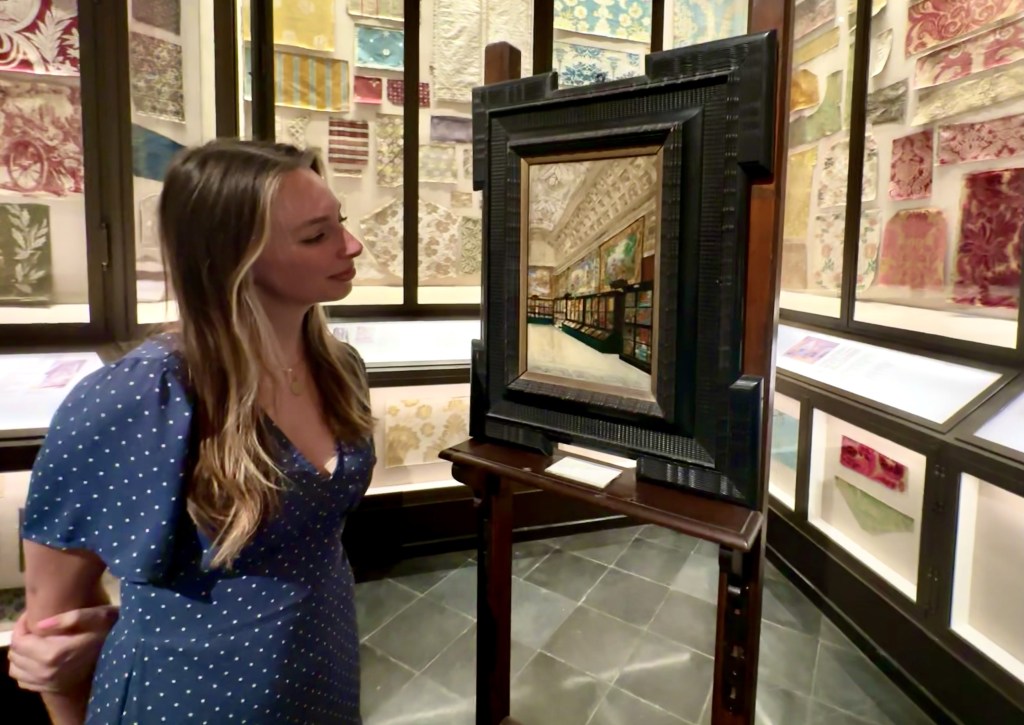
Classmate Looking at a Painting of the Fabric Hall Inside the Fabric Hall.
Furthermore, there are astounding exhibits of archaeology, art, ceramics, equestrian items, glass work, musical instruments, paintings, sculpture, silverware, terra cotta, and textiles.

Close Up of The Painting of The Fabric Hall, That’s Inside The Fabric Hall.
At this point a personal observation is in order. Before visiting the MCM with our class I viewed the both museum’s website and the local tourist bureau’s websites (see References). I erroneously concluded “No way to organize all of this.” I’m happy to say I was wrong. I came away from the MCM with a great deal of appreciation for not only what they had but how they displayed such as vast quantity of things in a meaningful, very organized manner.
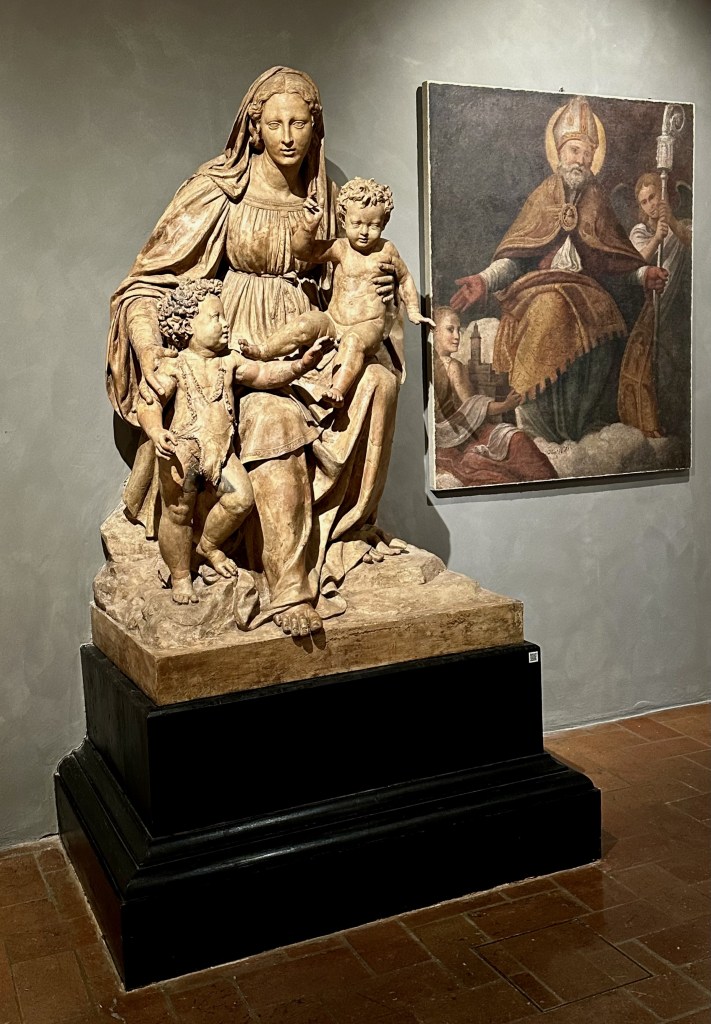
The Best of Everything at the MCM. A Little Crowded? It’s Still Beautiful!
But that is not all there is. In the museum’s archeology section is il (or la) Terramare. The title doesn’t mean “land by the sea side.” It means “fertile soil.” This very large collection displays many local Bronze Age artifacts, including jewelry, tools, utensils and jewelry.

A Roman Monument Discovered In 2007. (Does It Say “NO Parking?”).
To gain a deep understanding of the many collections would require weeks or months of visits. The good news is that the museum is organized is such a way that a visitor can utilize the online information and a free hard copy map to first seek out the particular collections which interest them the most. The paper museum map, perhaps better described as the paper floor plan, is free and available in several languages.
As the floor plan indicates the MCM is organized into 16 collection areas which fall within these five categories: 1st Art & Craftsmanship area, Archaeology area, Ethnology area, 2nd Art & Craftsmanship area, and the Temporary Exhibitions area.

I Passed The Quiz – Yes, It Is A Baroque Frame, Most Certainly, I’t Must Be.
Following a growing and positive trend, the MCM has taken all the necessary steps to ensure that all of its collections are fully accessible to visitors with limited mobility. The elevators are large and easy to access at ground level, without steps, at the west entrance.
It should be noted that the museum’s website prominently displays this online notice in its Useful Information Section. “Limited mobility – The collections are easily accessible for guests with limited mobility; the entire exhibition itinerary is free of architectural barriers. The elevator provided for limited mobility guests is marked on the map” (see MCM, n.d.).

Rooms and Rooms with Drawers and Drawers of Fabric, Wallpaper, etc.
Speaking of websites… The city’s Tourist Information Bureau has an informative webpage designed to encourage people to visit Modena and include the MCM (see Visit Modena).
Should anyone in the greater public read this posting I want to convey to you that going through a distance learning program, especially at a graduate level has many challenges. However, this experience has been a tremendous opportunity to learn not only from our great instructors but also from fellow students who are employed in various careers.
Our class includes two PhD level instructors plus archivists, curators, an engineer, historic preservationists, a land conservationist, heritage site managers, interpretive rangers, an observatory manager and several others. We receive in depth, usually behind the scene, orientations and/or tours to begin applying the knowledge that we’ve learned from our previous cultural heritage and museum studies courses in a real-world environment.
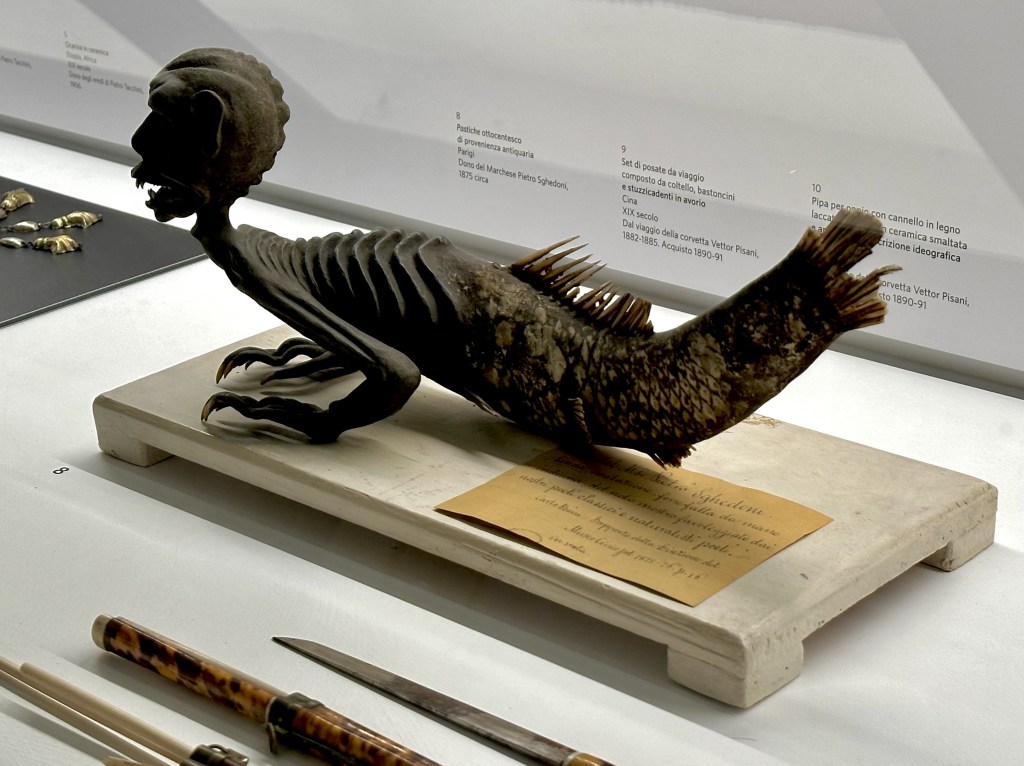
Possibly Acquired from P. T. Barnum or Ripley’s Beleive-It-Or-Not ???
The topic I most often overheard from fellow after visiting the MCM was repatriation. This was definitely driven by the fact that so many cultural items on display were collected by Modena’s citizens traveling to foreign countries and returning with them in years gone by. Attitudes and values have radically changed over time, thus many things collected in the past could not be collected today. There are national and international laws controlling, limiting, or in most cases strictly prohibiting removal of “items of patronage.” But the idea of repatriation is essentially saying “give us our things back.” Many people involved in heritage and museum careers have to deal with this issue in the course of their duties. This is inherently a complex issue with many differing viewpoints and often at opposite ends.
A somewhat dated but relevant article on museum reparations/repatriation appeared in the popular UK paper The Guardian. See References for the link to the article, “Museums grapple with rise in pleas for return of foreign treasures.”

Our visit culminated with a second lecture from Signora Francesca Piccinini, PhD. She is the MCM director and the local site manager for Modena’s World Heritage Site. When she responded to a question asking if her two positions were interlocked, she stated something to the effect of “for the time being.” Dr. Piccinini (of her own volition) expressed her disappointment regarding control of funding for the MCM. It was recently modified by the municipal government. It has taken a good deal of financial authority away from museum staff. The change essentially puts the money (and thus the power) under more control of municipal (and possibly regional) politicians and less for museum staff and its directors.
As students we are extremely grateful for people like Dr. Piccinini who with tremendous amounts of work responsibility still take time from very busy schedules to meet with us.
References:
MCM, n.d., Museo Civico di Modena, Modena, IT.
(*) Visit Modena, n.d., THE CIVIC MUSEUM OF MODENA – webpage. Official Tourist Information Site of Modena, Italy. https://www.visitmodena.it/en/discover-modena/art-and-culture/museums-archives-and-libraries/modena/the-civic-museum-of-modena
Wilding, M., 2019. Museums grapple with rise in pleas for return of foreign treasures. The Guardian, online UK News, Monday, 18 Feb 2019. https://www.theguardian.com/uk-news/2019/feb/18/uk-museums-face-pressure-to-repatriate-foreign-items
Note: UNIMORE is an acronym for Universita Delgi Studi di Modena e Reggio Emilia.
 Grande Giro di Modena